sure you can just make a new one, but all of your old posts and comments won’t show up. Not to mention your DMs too
it seems kinda counterproductive to the goal of lemmy being federation where you can just move to another instance if yours gets bought by Elon or an admin goes corrupt, but it’s not made simple to do that.
I’ve seen many people be on lemmy.ml that would switch but they’ve been using it since the start of lemmy and they don’t wanna restart
I know mastodon has a little “hey this user has moved to @user@newinstance” popup but that’s not really that elegant either
How do you transfer email accounts?
Easiest way is to use IMAP connections - assuming you use IMAP normally to store email on the server (as almost everyone does these days - very few use POP3 to download them and remove from the server).
There’s a few little utilities or even websites (last I checked) that can assist in the process. Some try to charge money.
If you have access to Linux (or WSL on Windows), you can find ways to do it for free from a terminal window.
But even then, that’s just you moving data. You aren’t changing old emails to have them reply to your new email and you aren’t auto-updating how the rest of the world interacts with you.
Same reason it isn’t easy to transfer your Apple account to Google.
They are completely separate sites, that just happen to talk to each other.
Nonsense/disinfo. Apple and google accounts are hard to transfer because of technical differences, whereas on the fediverse they use the same format and everything.
You can’t do it on fedi because nobody’s built a mechanism to update all your content to use the new account.
Sure, it might not be completely accurate, but, it’s essentially the same idea, and should help basic understanding of the question asked.
It gets like half the info right, that’s not a good answer. Others in the thread have done a much better job of explaining it simply and well
It’s actually not a good analogy.
To be fair, the blanket term of technical difficulties is the reason it doesn’t happen on lemmy too, security and ownership wise
Difficulties yes, differences no. The account is represented the same way on both instances.
My guess would be because they’re all independent instances, not a monolithic parent company like social media…but that’s just an early morning, no coffee spitball.
I agree. This could be abused.
- create your own instance
- manually update your instance’s database to make it look like your account is so old with tons of comments and posts
- migrate your account to another instance.
Now your 1 week old account appear as a 10 year old account with 100s of contributions and 1000s of upvotes.
This could be mitigated by having migration tool validate each comment/post against the data obtained from the instance the comment/post was placed at.
But this is too much work and probably still not fool proof
Yes, that’s possible… but at the same time… I don’t think anyone or anything (at least to my knowledge) cares about account age or “contributions” like if this were reddit or Facebook or something. I could be wrong though and just haven’t noticed it.
Personally, when I see someone post something that seems out of place or doesnt sound like a good faith argument, I’ll check their account to see how old the account is and what else they have posted.
To me, that does matter as it shows whether they contribute or how they contribute to Lemmy and for how long. If they make a new account and immediately start posting garbage or AI slop, I block them.
If they have opinions I disagree with but still try to make a sound argument, thats fine. I take issue with spam and people who just troll, not with people who post because they want to discuss things even if we differ in views or beliefs. I don’t want an echo chamber yknow?
Thats all just my opinion and what ive seen since joining Lemmy for the past 3 years.
I get that, but in my opinion that is the bar for anyone regardless of account age; AI slop, bad faith arguing, general dickheaded behavior gets a block regardless of contributions or account age.
Fair point, I guess I meant that account age is also a factor when determining whether to block someone or not or if they’re just joking or being a dick.
It factors in because if its a pattern, it makes more sense to block them. If not, maybe they had a bad day or the tone of what they meant was off.
Hell maybe I misunderstood what they meant.
I prefer it this way. The point of a new account is to lose the tail.
If you create a new account you always start fresh regardless.
OP is asking why there is no mechanism for migrating an account available for those who need this feature.
The current mechanism is linking the accounts to each other, which is “good enough” that there’s not a pressing need for actual migration, especially since it’s a feature more users will never need.
If you create a new account you always start fresh regardless.
Settings, subscribtions and blocklists can be transferred to new account.
The point is that they want to keep the content of their account without losing it all.
But you don’t have to delete the old account, it’s still there. It’s just like having a new email address, only easier in many ways.
There is no good way to transfer already sent messages and written posts. Transfering all satabase entries connected to your user account may be possible, but depending on how active you’ve been, this would already cause a lot of traffic. The next issue is images. Do you transfer them also? That would mean even more traffic. How do you handle federated content? Your messages not only live on your home server, they are duplicated to all federated instances. You’d have to contact all instances to change owner of those posts. Alternatively, your old server would have to keep redirecting to your new account. All in all, there are so many edge cases to consider for so little gain, it doesn’t make sense to invest dev time into it.
ActivityPub (which is the protocol used by Lemmy, Mastodon, PixelFed, and other fediverse platforms) doesn’t have a built-in system for account migrations. Accounts are tied to an instance. Any migration features are handled at the application level, like Mastodon’s, and will be limited by the protocol.
ATProto, which the protocol used by Bluesky, has a more complex account system which does allow for migration. I’m not intimately familiar with the details, but the gist is that your DID is not tied to your instance, and your data store can be independent as well. I don’t know how this works in practice, since the ATProto ecosystem is basically just Bluesky, and a few other things that piggyback on Bluesky accounts. It appears to be at least a little complicated: https://www.da.vidbuchanan.co.uk/blog/adversarial-pds-migration.html
Honestly, yes, this is a problem with the design. ActivityPub is not resilient against servers going offline or going rogue. It’s a lot like email. If you change email providers, that means a new identity, and all you can do is point people to it as best you can.
I think it’s best not to get too attached to your profile, I’ve moved several times and if anything it’s nice to throw off the weight occasionally. It’s not like there’s any karma to lose, it’s not like your past posts and comments go anywhere. You can export/import all your settings, including subscriptions, blocks etc. I can’t think of anything else you’d need.
A paper trail from before 2018 to prove I’m not a bot?
I don’t see how it could work.
If you copy all your posts and comments to your new account, do they just get duplicated? What about all the 3rd party comments/replies to your post, do they get duplicated, too? Or does your new account just exist with bunch of old duplicated posts that have no comments? It would be a total mess.
You can copy over all your settings, subscriptions and blocklists. That’s more than enough.
You can migrate accounts over Mastodon instances, I don’t know why is not something similar implemented in Lemmy.
It seem you can transfer your followers to the new account, but I don’t see anything about it actually transferring your past posts. So it seems to be quite similar to lemmy.
It would not be that hard. There just needs to be a way to federate the change.
-
Authenticate the new account. This could be as simple as an account admin code that is only available when logged in, or authenticated through the old server.
-
Scrape the old account for links and backlinks. Federate changes so that they link to the new account.
-
You might need a workaround for mentions and follows. Those would be spread across other users’ accounts, so probably not fixable.
-
Copy any content that was not already federated to the new host.
If devs wanted to, they would. They don’t want to. I guess you could ask them why.
-
I’ll take a stab at answering the titular question, which also requires answering the related question: “what really is federation?”
In my conception, federation makes the most sense if we rewind to a (almost) bygone era, in the early 21st Century where every specific communities hosted their own web forums, before a time when Facebook groups or Discord “servers” were mainstream. Of those, I think the ones which endured the longest are those related to automobile enthusiasts, usually about a specific model (eg Corvette), in order to exchange tips and servicing info.
What federation solves is the challenge of maintaining a different login – aka identity – on each web forum that someone frequents. Back then, it was a separate username and password for the car enthusiast forum, another for the regional gossip forum, yet another for the anarchist forum. And despite that, the underlying credential was usually the same: an email address.
So instead of managing an identity at each different web forum, federation is the idea of having a single identity that can travel to different domains. The open model of email is instructive, because sending an email necessarily interacts with the destination domain, which is usually not the same as one’s own. Phrased another way, the postal system was the first federated communication system, where different states honored the single identity and allowed free* passage. One might compare this to one of the EU’s four freedoms, the free movement of labor: a user may do work (ie write a post) on any instance in a federation, on equal standing whether they’re local or not.
In the modern context in the 2020s, such a freedom is in stark contrast to the commercial alternatives: using a Facebook, Google, or Apple login to access any particular website more often than not puts oneself on a different (ie lower) standing than if they logged in with an untethered account. The usual problem is that such a common identity is tracked and sold to marketers, which explains why so many sites use these single sign-ons as a default, and only begrudgingly support “old school” account creation for that specific site.
And worse so, if Google decides you are unworthy of a Google Account, then you simultaneously lose your online identity and any semblance of access to those services which you were using. Federation solves the latter, because if your federated identity is banned from your home instance, the freedoms of federation means you can create an identity elsewhere and use that to access Fediverse services, apart from the one which originally had reason to ban you.
Nobody can deny you access to every instance, and that’s what makes it powerful: there is no centralized arbiter for the network. Sure, this means there will be some very ugly parts of the Internet that get to exist and possibly interact with the rest of the decent web. But just like with the majors, the challenge of moderation still remains albeit different. Some segments are wholly an island unto themselves (eg certain right wing circles that also use Fediverse software) because nobody else will federate to their instance.
Going back to the original question, the central issue is that while the network is decentralized, a single identity necessarily is centralized on their home instance. And there’s no real way around this, because having a single identity means it must be unambiguous to reference: if I @ you, there must be exactly one possible identity, or else everything breaks down. So the notion of “transferring” an identity would become a horrible routing kludge like how “portable telephone numbers” are implemented in the Telco space: the original exchange has to remain alive to forward to the new exchange. And that’s basically unworkable in the decentralized Fediverse in general, because instances can come and go.
There is no way to guarantee that one’s home instance stays alive forever, which limits the identity’s lifetime. If we had it leave a note that you’ve moved, how to we retrieve the note after the original instance is down? Telco could do it because there’s a centralized listing of all valid exchanges, but there is no such thing on the Fediverse. It’s the sort of thing that requires a “dying message” ledger, and it’s hard to imagine how something like DNS could solve that knowledge challenge issue.
At bottom, creating identity resilience is hard and we don’t have it yet. But that’s because federation was always going to be difficult, and in spite of that, we seek out the world we want, not compromise with the world we were given.
Only possible alternative i know of is what Bluesky is doing - separate out the identity part into another service. Changing the location of the identity can then be resolved by updating the id that a comment is attached to; this edit can then be lazily be federated to prevent long standing accounts from grinding smaller instances to a halt.
But that needs a lot of changes for a small payout - if you are on lemmy to establish a following, you probably haven’t understood Lemmy.
My cursory understanding of the BlueSky/AT approach is that posts are not anchored to the identity, but to a value akin to a DOI like how research papers are referenced. And in that way, something like a BlueSky post can be hosted as a standalone document, whose provenance is through a linkage to the user identifier maintained by the separate identity infrastructure. I believe this is why hyperlinks to BlueSky posts do not – and cannot – include the author’s handle, whereas Fediverse links often do (but aren’t required to).
So yes, the server that hosts content is separate from the identity server. But the part I still don’t see is how to update a document’s associated identity if a user changes to a different identity server. It is indeed a separation of concern – which is very healthy and I do follow developments in the AT space which could be used to drive improvements in the ActivityPub world – but the same scenario is still doomed: if the identity server skips town suddenly, can former users restart with a new identity and reassociate to their prior documents? How can this be done securely?
But my original point remains: the challenge is nontrivial and no one should underestimate the complexity, whether it’s in the ActivityPub or AT model. This federation thing is hard.
I would love if at least the block list and subscription list could be moved more easily.
It is not well labeled, but you can.
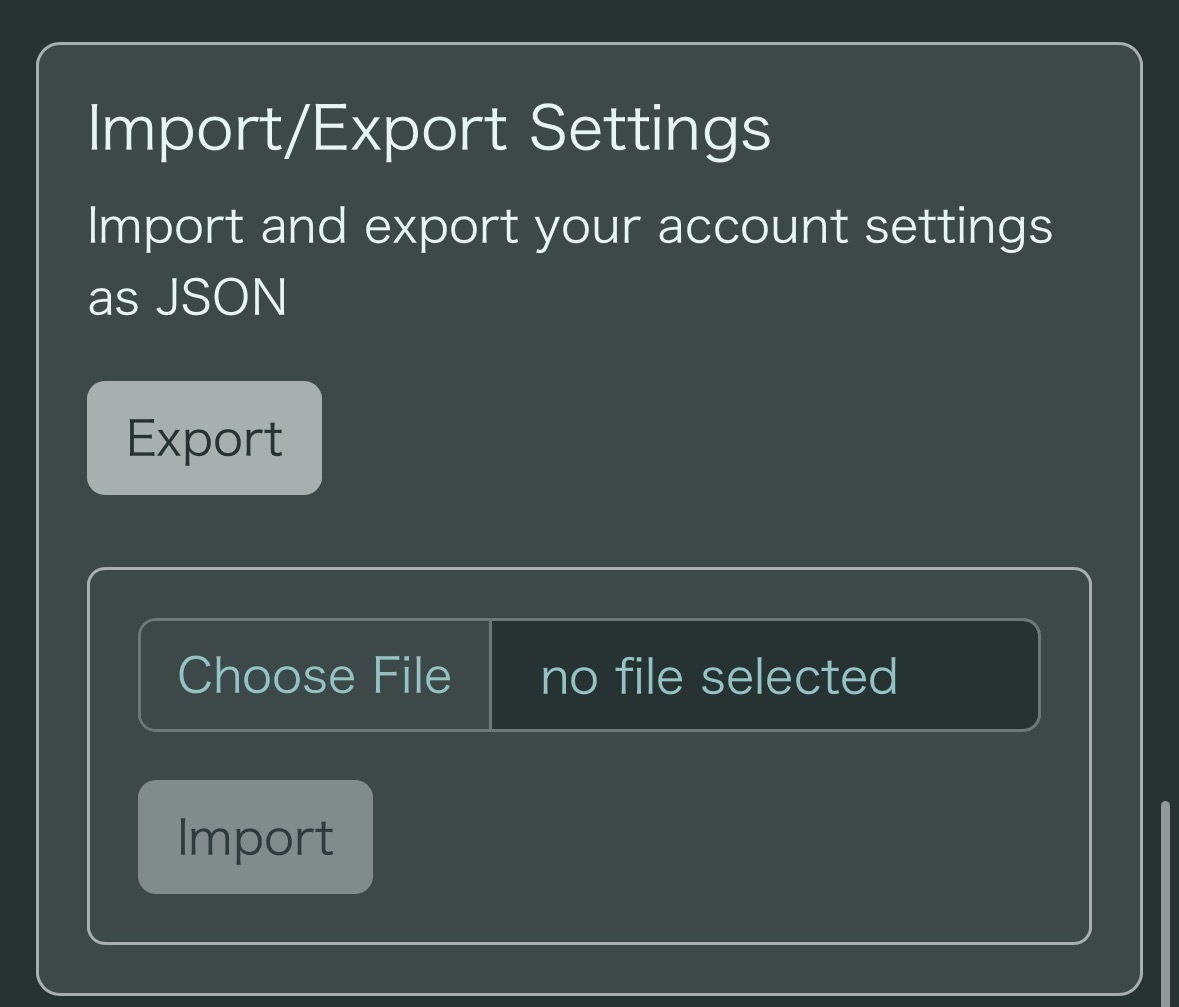
Hamburger menu on the top right, tap your profile name, settings and scroll down to this.
People DM on Lemmy?
Yes, why not?
So youd like to have more of a centralized kinda thing? Maybe try Reddit.
Doesn’t Piefed have that feature?
No it’s like Lemmy where you can export/import subscribed communities plus Piefed/Pylova “can” export user block list too, in theory. When I moved from Piefed.social to Quokk, user block import didn’t actually work but that was months ago.