
See also https://xkcd.com/3167/

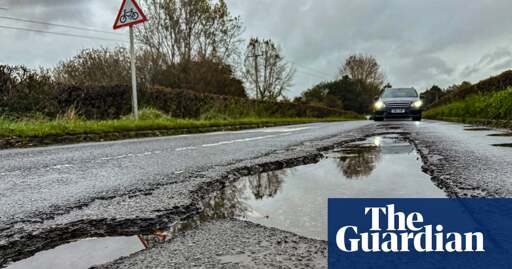
As somebody who lives in SUV-ville, yeah, our roads are the word I’ve ever seen.
Road wear is ~n^4 where n is vehicle weight. Of course it’s because of SUVs.
So if if a 400 lb motorbike costs 1 penny per mile in road damage, the 4000 lb SUV should be paying 60 bucks and the 40,000 lb tractor trailer 1 million dollars?
Or is it divided by contact area?
Of course but fuel taxes increase because their mileage is better (more pounds per km). SUVs should pay more taxes proportional to their weight and height. I now see SUV-like vans that could ram twenty children before noticing anything
Removed by mod
You are incorrect.
First, all three are scientists with active research interests:
- https://eps.leeds.ac.uk/faculty-engineering-physical-sciences/staff/11618/dr-ali-rahman
- https://www.lshtm.ac.uk/aboutus/people/goodman.anna
- https://www.kellogg.ox.ac.uk/our-people/christian-brand/ (where you can see he does in fact hold a Masters and a Doctorate)
Secondly, you appear to be comparing a “crossover” SUV against one of the worst EVs, one that was released in 2019. As a point of comparison, my Leaf has a minimum kerb weight of about fifteen hundred and something.
Prof Christian Brand, the emeritus professor in transport at Kellogg College,This guy doesn’t even have a degree.
I really hope you are a troll lobbying for the car industry … because a rando questioning the credential of an Oxford professor which we can verify with a single DuckDuckGo query reading “Professor Christian Brand is an interdisciplinary environmental scientist, physicist and geographer with over 25 years research experience in academic and consultancy environments.” from the page of one of the most prestigious university in the World, for centuries, is really weird.
It doesn’t mean though that appeal to authority is right and thus that whatever Prof Christian Brand writes is correct. It’s not because he’s a professor researching in the area of expertise of the paper that he’s right… but his credentials are definitely on point.
Pretty sure they are scientists. It’s a broad term as far as I know, and anyways these are (probably) smart people (judging by their titles/jobs) and what they are saying or concluding from data is just common sense: heavier car = more wear and tear on road surfaces.
Anyways: Are you saying it could be EVs too? That’s probably likely to be causing some of this too, I think they are generally 500kg heavier than gas cars.
Another reason to add to the “EVS ARENT THE SOLUTION” pile?
Egoist mentality : “I’m scared of others, I need a car that looks like a tank so that at least I’m safe, even it means other are less so.”
Arguably capitalism is fostering “optimizations” but unfortunately it does so entirely amorally. When the only metric is profit then everything else becomes a negative externality to ignore.
TL;DR: yep.
Why target SUVs when EVs are even heavier.
They’re actually very similar weights.
Because they aren’t.
because suvs are unnecessarily heavy and evs are not.
Good, sell your car and ride the bus/train. If you live somewhere that isn’t feasible, move somewhere it is.
Every pothole that makes keeping a car untenable is actually the hero every traffic cop thinks he’ll be someday.
The group that’s most at risk due to bad road conditions, motorcycles, did nothing to deserve this.