

For this reason, elected authoritarians who wish to consolidate control typically win not by flashy displays of might, but by convincing a critical mass of people that they’re just a normal politician — no threat to democracy at all.
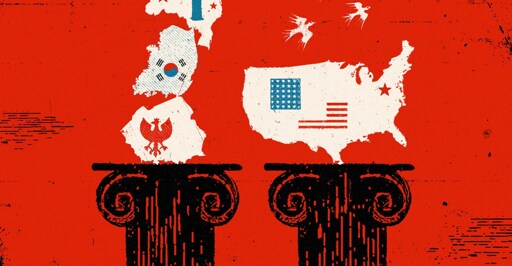
That means the survival of democracy depends, to an extent not fully appreciated, on perceptions and narratives. In three recent countries where a democracy survived an incumbent government bent on destroying it — Brazil, South Korea, and Poland — the belief among elites, the public, and the opposition that democracy was at stake played a critical role in motivating pushback.
Sorry, but I don’t think this will do it. We got into this situation because social media in general allows for fine-tuning manipulation and propaganda to specific audiences, not because they’re centralized. Facebook and Cambridge Analytica were probably a but-for cause (and there are many) of Trump’s first win. But it wasn’t because Facebook was actively trying to help Trump, as much as it was because social media both democratized and bastardized journalism.
If everyone switched to Lemmy, Russia and others would now just focus (as I think they already have here in election years, but to a larger extent) their resources on Lemmy disinformation campaigns instead of X and Facebook. If the userbase splintered to 100 different apps instead of any centralized one, likewise targeted misinformation would follow. And viral misinformation would cross platforms, just like it already does.
Yes, education is the long-term answer.
Yes, that’s true. The Fediverse is also susceptible to manipulation. That’s why I’m not a fan of broad rules such as “no politics” in the largest communities, as their breadth would make it easy to buy off a few moderators, which shouldn’t be a problem at all if you have even a little capital.
Nevertheless, traditional journalism is dead because its business model is simply no longer financially viable today. Investigative journalism is very expensive and, with the loss of advertising revenue (wnet to search engines and mainstream social media apps), it is simply an impossible business model today. In fact, most of the traditional media today is run at a loss by billionaires like Bezos (Washington Post, among others).
I’m not saying that the Fediverse is a promise of salvation. I’m just saying that it’s the only option left.
The internet as such was originally designed to be decentralized, but it was taken over by big capital, for which we are now being presented with the bill in all the remaining democracies of the world.
In my opinion, the only response can be to do everything possible to return to decentralization, in order to at least put obstacles in the way of the powerful of this world.
I understand the sentiment and agree with the diagnosis. I just worry that the proposed cure won’t address the illness. Decentralization is a band-aid at best.
I think the traditional journalism business model is just a proxy for “truth” in the sense that fact-checking and reliability is really what’s at stake versus social media “news.” And the substituted point is still valid - truth as a business model is no longer financially viable - but the cure I feel should be to make truth financially viable. One way to do that is to depress demand for misinformation (laws prohibiting misinformation and enforcement, creating boycott campaigns against platforms that algorithmically incentivize misinformation like Facebook and X). The other is to reward truth (educate the populace to support it, sure, but also keep funding as a social good journalism like NPR, PBS).
It’s not great, but I don’t feel just pushing into decentralized media will do anything except create even more competing “truths” and hasten information exhaustion. That path leads to Russia, where the populace seems mostly nihilistic and too jaded to act.
Yes, it would be desirable if truth were rewarded and deliberate false information punished. Unfortunately, neither is even remotely realistic:
True, or at least objectively researched, information was the business of journalism, which for the reasons mentioned above now exists only as a farce of itself (but still retains parts of its former reputation as a reliable source of information). I just don’t think there is any way to make journalism work in the age of the Internet (and I’m from Germany where we have publicly funded media).
Criminalizing misinformation would in turn require appropriate legislation. And as is always the case with laws, those in power would use them to make their worldview the only one that is widely disseminated. To see this, one need only look to the US, where the criminal but also wealthy president is already using current legislation to sue anyone who dares to make him look bad.
So, I think the only option that remains, despite all its flaws and problems, is decentralized social media. Of course, it is susceptible to manipulation, but at least it is not directly controlled by those who want to manipulate the discourse in their favor.
It is certainly not a solution in the true sense of the word - in a purely profit-oriented system, there can be no such thing - but in my opinion, it would at least be an improvement on the status quo, in which people like Zuckerberg and Musk can de facto directly control what people perceive as their reality.
To a somewhat lesser degree, though, since there isn’t a pervasive and inescapable algorithm that aggressively pushes controversial engagement-bait posts on people.
(And also because public mod logs can make it more apparent when moderator capture is used to suppress and control narratives.)
404 media is turning a profit, which demonstrates this is not necessarily true