I heard a story from Japan where an American business man was sarcastic and the meeting got quiet. He was like “it’s a joke because-“
“We got it. We just thought it was inappropriate “
Edit: I stand corrected, see replies
(Not first-hand knowledge) I read somewhere that tonal languages such as Chinese make it difficult to express sarcasm the same way Indo-European languages do, with accent and inflection.This made me think, and I realized that non-tonal languages actually do have a tonal aspect to them.
Non-tonal simply means the denotation isn’t carried by tone, not that users of the language don’t use tone. It’s an interesting distinction.
John McWhorter has a few courses in The Great Courses catalog about language - its pretty fascinating stuff. He covers things like tonal languages, and how even for a linguist like himself, they’re tough to learn.
True, otherwise it would be monotone, though some people speak in a monotone voice that can put you to sleep.
Me as a native finnish speaker making every english speaker in a meeting unsure of my meanig
Can you explain please?
Finnish people are stereotyped to sound monotone, enunciate clearly, speak directly, and tersely. This makes them seem unfriendly.
And then they expect you to stay 3 m away from them at all times, which intensifies their seeming unfriendliness.
At least these are the memes.
Knew there was a reason I liked Finns…
When we go to a hotel, we prefer the Finnish level of service: make everything work and otherwise leave us alone.
Sounds pretty similar to US stereotypes towards Eastern Europeans, who are “always grumpy” and “rude”.
How Eastern Europeans see USians:
😁°º︎○︎( pls someone help )
As others explained, finnish is pretty flat and that carries to the other languages I speak. To english mostly, I refuse to speak swedish
From what I’ve learned from memes is that there is “enmity” between Swedes and Finns, am I correct?
I wouldn’t say so. Finns might feel like the little brother and feel unease about that. In practice there are lots of personal and commersial ties. Many have family in Sweden, me included.
We don’t expect Sweden to send troops if Russia tries to invade, planes and ships, maybe the odd submarine but no troops. At least that seems to be the sentiment
They absolutely do. Even within the same language, regional accents can have very different prosodies.
I recall reading a Nature article iirc about how neonatal cry melody can reflect prenatal exposure to parental language! How nuts is that!? Brains are cool.
eta: Found it: https://www.sciencedirect.com/science/article/pii/S0960982209018247Wow. Off to searching for articles in Nature! Hello rabbit hole…
Huh
(Not first-hand knowledge) I read somewhere that tonal languages such as Chinese make it difficult to express sarcasm the same way Indo-European languages do, with accent and inflection.
First hand knowledge, I’m Chinese American. My mom is from Taishan and I grew up in Guangzhou for the first 8 years before immigrating to the US. My mom uses scarcasm a lot. We speak Cantonese at home.
Example:
“我想去睇橋” (“I wanna go see the bridge”; a euphemism for I want to go to the nearest bridge and jump off to kms, and my mom knows the meaning of this btw)
Mom: “喂,使唔使載埋你去啊?” (“Hey, do you want us to drive you there?”; said in a very unusally happy and uplifting tone, as if she’d be glad to see me die (I mean… not really, I don’t think she really wants to see me die, I hope not, she’s just playing mindgames to “stop me from ‘attention seeking’”, she doesn’t understand what depression is.)
Or sometimes I get mad and refused to eat and mom was like: “哇,係唔係想練神仙啊?亦好呀,慳返啲食嘅。” (“Wow, are you trying to become an immortal being? That’s great, we can save some food”; again, with that weird “fake happy” voice.
And I instictively knew these were sarcasm.
That’s funny! Hopefully the sarcasm isn’t causing psychological damage.
I just did a quick research on tonal languages, it’s quite tricky for a beginner to grasp these subtle expressions. Imagine a life without sarcasm. Brutal. I wonder if they have their own way of conveying it.
They just carry around a card that has “/s” written on it and flash it as necessary
Sarcasm can be conveyed non-verbally. Through facial expressions, gestures or situational context for example. The core concept is not bound to specific languages but to the social/cognitive ability of the communicators, I’d say. Young children have a very hard time with sarcasm, regardless of where they’re born.
As someone who will live and die by snark in my online comments, I confirm. However, annoyingly, I’ve had a noticeably higher proportion of replies on Lemmy from people who don’t know how sarcasm works, than on Reddit.
Sounds like Reddit is a better fit for you then.
Even in English, sarcasm can be delivered very dryly in a way that would be undetectable without knowing context. It doesn’t need to be spoken with exaggerated tones. I do it too much.
Someone commented that his sarcasm was lost with, mostly, religious folks in Oklahoma, and I realized that yes it happened to me too plenty of times (but not in Oklahoma). So yeah, even in English it can be elusive to some people.
Yeah.
Impossible conveying a message of sarcasm if people cannot hear my voice.
That’s why there’s no sarcasm in the Internet.
Oh, they do. Depending on the context, there’s a whole host of ways to imply sarcasm without depending on intonation. Body language, context, double entendre, formality shifts, etc.
First-hand knowledge (I’m Cantonese), we have sarcasm.
I find it hard to believe that sarcasm can’t exist in some languages, honestly; just say something in an exaggerated tone while you mean the opposite.
true! and makes Sense.
It’s sometimes said that Japanese people don’t know and don’t understand sarcasm but really they just have different ways to make you feel stupid that don’t (necessarily) register as sarcasm to Westerners, like being overly polite.
I guess Japanese really doesn’t have in-your-face sarcasm now that I think about it…
Now that you mentioned it, Japanese also has a rather interesting quirk of not having what most people would consider as “swear words”. Read it somewhere that Japanese does have swear words, but they tend to be quite tame, and the words themselves aren’t “taboo” (as compared to just about any swear word in English)
Yep, certain words for example really just mean “you” if taken very literally but have taken on rude undertones (temee, kisama) to convey what Western languages would use taboo words for.
Relevant for anyone who cares about this sort of thing: https://youtu.be/GcjbwkBQeO8
Ah, portrait mode, let’s watch that real qu**26 minutes**
No, 26 minutes is not egregiously long, of course, I just realised that portrait mode sends that “short video” signal to my brain and it confused me for a sec :)
Lol, yeah. Most of his videos are a couple of minutes, but sometimes he wants a little bit more…
I didn’t know that they used politeness that way. Interesting. Crazy enough I have not yet interacted with a Japanese person in my life.
Drew Lynch is amazing! I’ve gotten to see hime live.
The whole StandupComedy subreddit has a hold on me like no TikTok could.
Hehehe that was funny.
Like the Southern expression “Bless your heart.”
Oh noooo, don’t be polite to me
I’ll do worse - I’ll TIP you!
Oh SURE. That makes so much sense that a culture would lack “sarcasm”. I can TOTALLY see that being a thing.
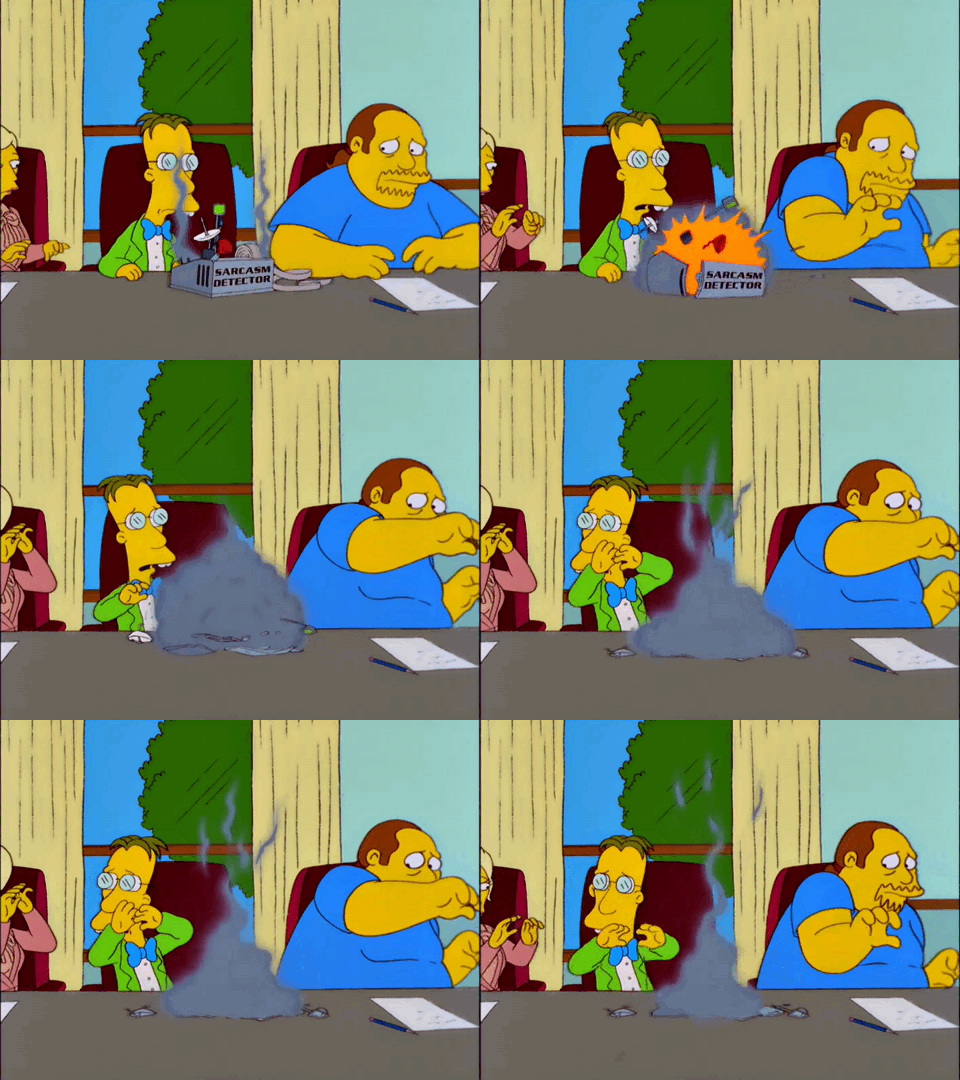
Hehehe
I’ve done a little bit of language studying and one thing I heard about repeatedly is that people tend to mistakenly believe in their own exceptionalism.
Like, their own native language has idioms, and they just assumed that other languages didn’t have idioms.
But we are all humans and languages are all going to exist in support of human communication. Therefore, you should assume that all languages have all major features of expression, including idioms and sarcasm.
Similarly, cultures are made from humans and to facilitate human interaction, so you should expect that things like sarcasm will exist in every culture.
So sarcasm would exist but not the way we understand it, does it mean that sarcasm is an intrinsic part of human nature?
A basic building block to humor is a subversion of expectations. Sarcasm is just stating things as the opposite of the intended meaning. Sarcasm is, in essence, the base level that most humor is built upon, and because of that is looked down on because it is “easy mode.”
Reminds me of a funny memory from the far distant past when a friend of mine, in a middle school Spanish class, expressed surprise that Spanish speakers use rhymes.
Oh I would certainly think it’s the norm but I do wonder if there’s some culture somewhere that really is just that literal. Like shit we don’t know what the sentinelese (but they definitely give a dark sense of humor vibe).
Nooooo, not at allll. /s
I lived in Oklahoma for 3 years and it took me ages to find a group of friends who understood sarcasm. I mean, even the drag queen server at my regular bar seemed baffled by sarcasm.
I think it was mostly the very religious people who had trouble and there are a LOT of very religious people in Oklahoma.
You know what, you’re right about that. There are plenty of times my sarcasm wasn’t caught by north Americans. That slipped my mind. Interesting 🤔.
There has to be. There’s loads of people on the internet that never recognize it even when it’s incredibly obvious or has an /s.
Goddamnit you’re right, another fact that i missed, besides being misunderstood IRL with English speakers too. They’re everywhere!
In Vietnam sarcasm is limited. Particularly in the countryside.
There is a constructed language that I suspect is free from sarcasm. (At least if it’s used formally)
Wow this is interesting, I never heard of this. I’m going to have to spend some time learning about it.
It’d be really hard to do sarcasm in Toki Pona too as there are so few words that it just wouldn’t register unless there was a prior understanding of sarcastic intent between the people conversing.
Pona mention!
pona o tawa sina :)
Definitely China and maybe Japan. In American culture I feel sarcasm is fun banter but coming to China and in Chinese it just makes one look like a jerk. I’m less proficient in Japanese so I cannot fully tell how my sarcasm was taken but I’m assuming a similar reception.
Look at the translations for sarcasm: 讽刺,反话.
Looking up the definition of sarcasm in Japanese I have no idea what this kanji is supposed to mean lmao 皮肉
Japan definitely has sarcasm, but it tends to be extra hidden behind politeness.
I believe 皮肉 means “skin of the meat”, or in other words, superficial. What’s being said is not necrssarily the intent of the words. Or, in other words, sarcasm.
Sarcasm can be used to be inclusive to someone (I’m saying this thing we both know to be untrue, imagine thinking otherwise! We understand one another.) or derisive (I’m saying this stupid thing you’d probably think is true because you’re an idiot and I want to make sure you know it.) I know friendly people who do the former a lot and nasty people who exclusively do the latter. I wonder if the former is more difficult to achieve among a foreign culture with a second language.
Some ahole from my old cult claimed Spanish doesn’t have sarcasm, but that can’t be true. Every Spanish speaker I’ve ever met has been more sarcastic than an American teenager.
I’m curious, what was your old cult?
Jehovahs Witnesses.
Cool.
Irony is almost a national sport here in Spain. And yes sarcasm is widely used, but mostly in closed circles.
Oh suuuure!
American.
I once heard about a tribe in South America. Say a man had four wives. If he was asked how many wives he had, and in that moment he only could see two of them, he had to answer “I have two wifes”. I wonder if in this culture sarcasm would be a thing.
It seems that people in this culture can only talk about what they see. Or the guy lacks object permanence.
This might be about the languages where the only “numbers” they have are “zero”, “one”, “a few” and “many”.
If a conversation was held in English, then for the speaker “two” and “four” are synonyms.