

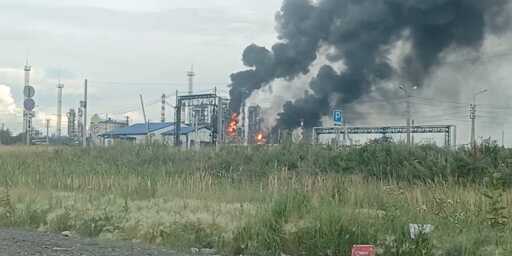
Ukraine struck Russia’s largest oil refinery, located in the city of Omsk, on Monday, marking what its forces say was its furthest-ever drone attack in the war.
The Omsk facility, which processes about 21 million tons of oil a year, is in Western Siberia and about 1,700 miles from Ukrainian territory — roughly the distance between Los Angeles and Houston.
We need some research into how effective drone strikes against refineries are to stop climate change. Are they a net gain in carbon emissions, considering the cost of manufacture and the prevented emissions?
You need to cut demand. If the price goes up, refineries are just build elsewhere.
Prices going up does help cut demand.
Back in the '70s when oil prices spiked, people started buying more fuel efficient cars, and drove less.
Today, after the Hormuz related price increases, demand for EVs has abruptly increased.
If the price of oil continues to increase, that trend will also continue.
There can be demand destruction from high prices
This. See how the hormuz crisis has caused many to pivot to renewables.
Perhaps, but you can’t tell me Russia can build them faster than Ukraine can destroy them. And in the meantime it means millions of fewer barrels worth of greenhouse gas emissions.
They can be built outside Russia.
Sure, but that’s not a solution for Russia’s own energy demands
I was thinking more of the globalized market for oil.
If Russia can export less refined oil, that can encourage the construction of new refineries elsewhere. This could negate the impact of drone attacks on reducing CO2 emissions.
But as others have said, there’s demand destruction that can have an effect.
How many years does it take to build a refinery from scratch? 3? 8? And perhaps a new refinery elsewhere will be a tad cleaner?
The real outcome however, could be that Russia tries to quickly apply bandaids to their broken infrastructure to get it up and running again fast. And that way their oil refining could become more polluting than ever.
I think on the global scale, Hormuz has a way bigger influence on helping many countries move towards renewables faster.
In many cases it’s cheaper to replace it with green alternatives. The refineries have competition from windmills, solar plants, etc. It’s not a given that new refineries will fill the gap in the market that destroyed refineries leave.
I do expect the destruction of refineries to be more positive for the climate than if they had continued producing. Especially if you factor in the demand for reliable supply and strategic availability of energy.
Raise the price enough, and the sold amount will drop. Also, people/industry will begin to look for alternatives.
Yes, there’s even a name for this: demand destruction.
Maybe in the past but there’s more alternatives now.
drones are cheap.
Gotta make it worse.
There’s the emissions from while it’s on fire plus some of the chemicals in it are worse after being burned like that then in regular emissions. Or become other environmental issues on their own once released/burned.
Then the emissions from building a new one.
It’s so much better to just shut it down because no one needs it than blow them up
Also on the comparison of “on fire” vs used as fuel - IDK about the emissions during the refining process, but when gas or diesel is burnt as fuel in a car, there are typically several emissions control systems reducing the pollution produced
I doubt the majority of engines consuming oil are euro-5 compliant: cargo ships, airplanes, military vehicles, electricity generators, water heaters, tractors, none of these typically use catalytic converters.
Good point, I was just thinking about cars. Cars are what typically takes the blame for pollution, but it’s really more the big industries doing it at scale
In Russia’s case, depending on how things go, that many not apply all that much.
If things go far enough it might lead to Ukraine striking construction sites of oil refineries. Still not great, but much less worse than an actual running refinery.
Do you think it won’t be rebuilt at all?
Here’s to hoping! Fuck Russia.
Well, the oil is going to get burned eventually, so it’s a question of “burn the refinery now” or “continuously burn oil from ongoing production now and in the future”.
deleted by creator
Lmao, no.