

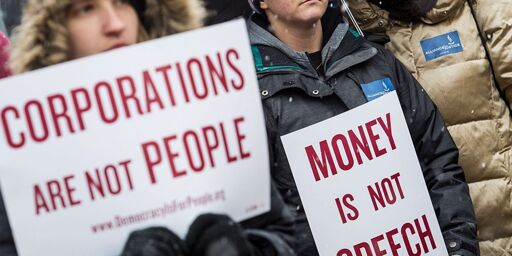
Delaware is home to more corporations than people. Human people, that is, as under longstanding state law and the US Supreme Court’s infamous 2010 ruling, corporations are people, too.
A judge in Delaware—a state with more registered business entities than people—ruled Monday in favor of a small town that allows corporations to vote in local elections.
Delaware Superior Court Judge Craig Karsnitz ruled that the town of Fenwick Island, population 400, did not violate the state Constitution by permitting business entities—which make up 12% of the town’s “population”—to vote in municipal elections, as case plaintiff the ACLU of Delaware had claimed.
“What is a ‘person?’ When one cuts to the heart of this case, that is the question,” Karsnitz wrote to open his 20-page ruling.
Good point. Let’s go again. If money is speech, then why isn’t the US Federal Reserve considered to be the most prolific writer/speaker of all time? And if money is legal tender, does that mean that some kinds of speech have within them the obligation of others to listen?
I mean I totally agree that money isn’t speech and that’s a bullshit ruling.
Just pointing out that A→B ≠ B→A. That’s a very fundamental point of logic upon which nearly all formal logic rests.
Edit: wow whoever downvoted this needs to go back to school.
Yes absolutely.
It is however not always clear-cut that “A is B” maps to A–>B as opposed to A<–>B. We do say “the square root of nine is three”, “a widow is a woman whose husband died” and “the current prime minister of Canada is Mark Carney”.
It is clear-cut though, and that’s why there’s a separate construct for A←→B. It’s the logical reduction of “A→B U B→A”.
If those were the same thing then it wouldn’t need a separate construct.
The reason “affirming the consequent” and “negating the antecedent” are formal fallacies is precisely because A→B does not imply B→A.
If the premise is A←→B, then those fallacies don’t apply because they’re biconditionals; either A or B can be the consequent or the antecedent.
“All apples are fruits” is a different kind of statement than “All widows have lost a husband.” Because “Apple → Fruit” but “Widow ←→ Lost a husband.”
And honestly that’s a bad example, because truly a man could lose his husband and he would be a widower, so honestly that one’s not even a biconditional. But most cases of equivalence and definitions are biconditionals, unless it’s merely mentioning a category or precondition that is not exclusive to the thing in question.
Formal logic is quite thorough about this kind of stuff, so if there’s ever a valid and sound deductive argument, it always holds true in every case. If it doesn’t, then by definition it’s either invalid, unsound, or not a deductive argument. Because a deductive argument that is both valid and sound always holds true.