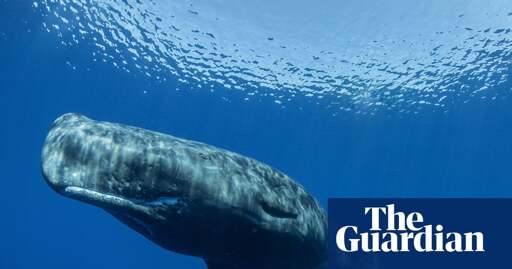
We may appear to have little in common with sperm whales – enormous, ocean-dwelling animals that last shared a common ancestor with humans more than 90 million years ago. But the whales’ vocalized communications are remarkably similar to our own, researchers have discovered.
Not only do sperm whale have a form of “alphabet” and form vowels within their vocalizations but the structure of these vowels behaves in the same way as human speech, the new study has found.
Sperm whales communicate in a series of short clicks called codas. Analysis of these clicks shows that the whales can differentiate vowels through the short or elongated clicks or through rising or falling tones, using patterns similar to languages such as Mandarin, Latin and Slovenian.
The structure of the whales’ communication has “close parallels in the phonetics and phonology of human languages, suggesting independent evolution”, the paper, published in the Proceedings B journal, states. Sperm whale coda vocalizations are “highly complex and represent one of the closest parallels to human phonology of any analyzed animal communication system”, it added.
Not if we keep allowing nations to harvest them (and their singular food source, krill) at the current astronomical rates.
Great. So what are they talking about ?
“Look! There’s a whale! Oh my God!”
You’d have to give the linguist time to sort it all out.
We’re still at vowels and tones…and maybe names (patterns that repeat when a specific whale shows up)
“These land animals be stealing our food and trashing our oceans. I’m fucking tired of this shit.”
“Same”
that documetary about it. Star trek 4. It was awesome.
that was a different species(humpback) of whale tho.
NNNEEEERRRRRRRRRRDDDDDDDD!!!
Maybe they’re doing it on porpoise…
Hi dad.
Yey they click Slovenian
Can confirm. I can speak Slovenian and always wondered why others can’t understand sperm whales.
Whales having similar vocalizations (I think using the term “phonology” is quite a stretch) to humans is a far cry from saying that whale communication is at all similar to human language.
Edit: Anyone want to explain their downvotes? Or are you all just that desperate to anthropomorphize whales for some reason?
Edit2: I shouldn’t have to flash my linguist credentials to express doubt about a sensationalist pop science article (no shade to OP - it’s an interesting article with some good info, so thanks for posting!). When it’s about something like new battery technology, for example, skepticism seems to be the default in the comments. Why should linguistics be any different?
Anyone want to explain their downvotes?
I didn’t vote you down, but I nearly did. Project CETI, an academic group of linguists, whale biologists, underwater acoustics professionals, and machine learning experts, say that sperm whale communication is highly complex, comparable in many ways to human language, and can be described as phonology.
Random internet user with no declared expertise or experience says, “nuh-uh” and provides no substantial counterpoint, and is confused by the negative reaction.
I don’t expect you’re wrong per se if the perceived take-away from OP’s article is that whales have language to the extent that humans do, but just being dismissive without bringing anything to the table is entirely unhelpful to the discussion.
I was a linguistics professor for almost a decade, and many of my comments here on Lemmy provide in-depth explanations from an informed theoretical linguistic perspective. See here and here, for example.
In my opinion, the phonetic (acoustic) resemblances are superficial, and nowhere in their paper do they identify the sorts of systematic patterns of alternations that constitute the phonology of human languages. It’s not just about seeing patterns in the sounds of the whales - it’s about showing that these patterns are specifically organized in a similar way to human phonologies, and that they also distinguish meaning in the same structured ways that human phonologies do.
But beyond just phonetics and phonology, and more importantly, the researchers haven’t provided any evidence that whale communication in any way resembles the systems of communication that we call “language”. Human language is characterized by specific features that aren’t found anywhere else in the animal kingdom in the same combination. To an extent the selection of these features is arbitrary, but the sum total of them makes a compelling argument for a categorical distinction between what we call human language and animal communication.
It’s possible, of course, that whale communication does in fact include all of these features, but the articles in question are a far cry from demonstrating it, and so using the word “language” is at best premature and at worst disingenuous.
This just seems like one of those sensationalist pop articles that come out every few months, driven largely by researchers without a significant background in theoretical linguistics, that do more to confuse people about the nature of language than to educate them. Language is much more than just “patterns of sounds that convey meaning”.
(And, for some reason, like 70% of these articles are related to whales. The two most common responses I get to telling people I’m a linguist are: 1) “How many languages do you speak?” and 2) “You know, I read this article recently on how whale language is really just like human language”. I have yet to understand the obsession with whales.)
You really should have lead with some of this! Hopefully you can see why your original comment, in a vacuum, wasn’t especially constructive or enlightening.
It’s no surprise that a pop sci article makes bolder claims than the paper it’s based on (even if you think the paper itself is overreaching); this old PHD Comics diagram is as relevant as ever.

“I shouldn’t have to tell you about my expertise for you to find my input valuable!” Weird hill to die on, but okay