

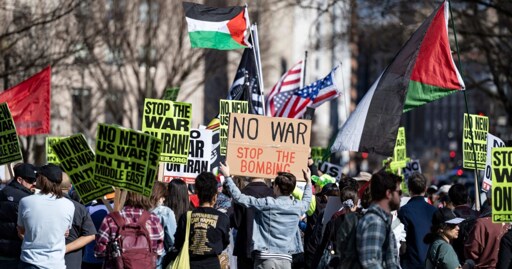
Just one in four Americans supports the Trump administration’s ongoing strikes on Iran, according to a Reuters/Ipsos poll released on Sunday.
The disapproval rating was 43 percent, while 29 percent said they were not sure.
About half of respondents—including one in four Republicans—said the president was too open to using military force. The poll surveyed 1,282 US adults starting on Saturday, following news breaking of the strikes.
https://www.ipsos.com/en-us/more-americans-disapprove-approve-us-strikes-against-iran
counterpoint: it tells us something.
Aye, that IPSOS are shite.
They polled 0.00037509% of the population and then make authoritative claims about the entire nation’s sentiments.
They normally poll more people than this in the UK, a country with 5 times less people than the USA. So why so few people for a USA poll?
Do you not know how statistics work? You can make a pretty good estimate of a population with a relatively small sample size. That’s why polls work.
Like, the only issue is finding out if your poll is biased or not. This is pretty bog standard statistical analysis.
But, as an example, imagine you had infinite coins. How many heads do you think you have to flip on randomly selected coins to make a relatively good guess on the chance of flipping heads? Because my guess is that you wouldn’t say infinite. You could probably get a good guess with 100. Flipping more coins just makes your guess more accurate, but it will be pretty close to the answer.
Basically, proportion of population is just going to affect the confidence interval, and that is basically within 2.7% points for the 43% say bad and 2.5% for the 71% who do not approve.
That’s… Accurate enough.
Aye but there’s only so much you can water down your sampling before it’s ridiculous.
1,282 people is less than the amount normally polled in a country 5 times smaller.
If they only polled 10 people would you be arguing the same or would that be deemed a ridiculously small sample size?
Also bear in mind that they’ve claimed to have weighted the data for 8 categories, some of which have multiple variations within them. And they’ve managed to do all of this with such a small sample size? Utter shite.
I’m not saying I’m opposed to the idea of Americans being against the war, what I’m saying is it’s disingenuous to make authoritative claims, like the headline makes, on such a small sample of data.
Okay, clearly you don’t understand. Let’s review.
If I flip 100 of my infinite coin, how accurate will my estimated mean be in comparison to my true mean?
Let’s assume we flip 50 heads, so we reasonably assume there is 50% chance to flip heads. Well, our 95% confidence interval (the usual one used) says that there is about a 9.8% range our true heads mean could be in. That means, 5% of the time, our actual heads flipping percent is outside that 40.2 - 59.8% range.
Now, here’s the biasing that we factor in: we’re gonna assume that our flipping chance is a standard deviation model, and that our actual mean will fall into this pattern. We assume, more or less, that people’s opinions fall into this model, too, and that isn’t relatively weird for polling data to assume, even if it isn’t completely representative of the true population.
If you flip, say, 1000 coins instead and got 50%, how much does that range shrink? I mean, it doesn’t shrink by a factor of 10, but by a factor of √10. This shrinks us by ~3.16, so the range becomes 46.9 - 53.1%. That is a lot smaller, but not, ya know, 10 times smaller.
The point is that having 5 times less participants would only widen the gap the true participants by about 2.2x… So instead of 2.7% interval, you would have like +/-1.25%. That’s, again, not going to shift the likely guess by much.
Because that’s just how random sampling works. You have a chance to be outside that confidence interval, but it’s just not very likely. Because increasing the confidence percent is ALSO a square root ratio. At 99% confidence, the range becomes 3.57%.
So, yes, surveying 1200 people, assuming random sampling, is pretty representative of the US. Your goal is to find the biases that shift the data away from representing the true mean, not to question how sampling works because math is not on your side. Sampling works, period.
And using weighted data for categories? Again, since all of the data was transformed in the same way, I don’t see the problem, unless you have a problem with transformations in general. This is a higher level concept in statistical analysis, but this is probably just averaging out 8 questions into a 0-100% scale, which isn’t particularly obscure or unique in sampling. If anything, this should shift the data closer to 50%, so any deviations away from 50% would be notable.
Simply put, your problem with the sampling method? Doesn’t exist.
You don’t understand how statistics works.