

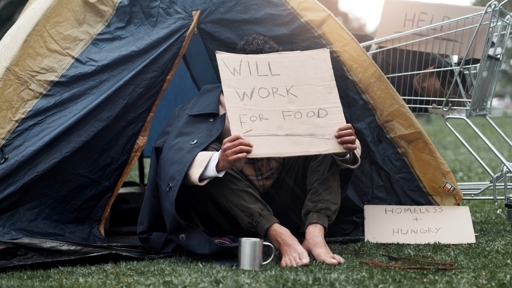
The term, borrowed from competitive gaming, refers to a health threshold where a character is vulnerable to an instant, unblockable finishing move. In the context of American life, Chinese observers use it to describe a terrifyingly low “margin for error.” This is the point where a single stroke of bad luck—a $3,000 ambulance ride or a sudden layoff—triggers a terminal collapse into homelessness.
This shift in perception is driven by radical transparency. For the first time, the “American Dream” is being filtered through the lens of real people rather than Hollywood studios. Through international students and overseas Chinese on TikTok and Weibo, the “unfiltered” America has been revealed.
Instead of the manicured suburbs of Desperate Housewives, Chinese netizens see the sprawling tent cities of the West Coast. They witness the “Great Reckoning” on Xiaohongshu, where American users share medical bills that look like mortgage statements.
Most people who hit the kill line have someone to go live with.
The tent cities aren’t a symptom of two totally different issues: mental health and drug addiction.
And THESE are due to a more endemic cultural issue of: who takes care of people when their friends and family won’t, coupled with the people rejecting the help that’s offered because from their perspective, the tent cities are better than the alternatives?
thats a rather broad generalization. If and when my wife and I hit the kill line we will not have someone to go live with.
Of course it’s a broad generalization; my point was that the tent cities aren’t predominantly made up of people who hit the kill line, that the situation isn’t that simple.
Fixing the kill line won’t affect tent cities that much; there are further societal issues that are also at play.
In China, substance abuse is handled differently as is mental health issues… so you don’t end up with those people in tent cities either.
This doesn’t mean those people don’t exist in a state of suffering; it just means they’re not publicly visible.
Respectfully, this is kind of incoherent. I can see that you disagree with the characterization of America’s poverty trap, but I didn’t really understand what part of the fundamental thesis of the article you dispute.
Totally incoherent; the first half was meant to be a reply to a completely different comment. Fixing.