

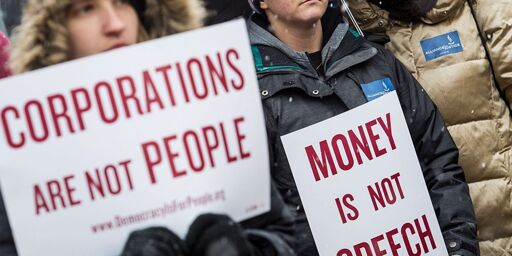
Delaware is home to more corporations than people. Human people, that is, as under longstanding state law and the US Supreme Court’s infamous 2010 ruling, corporations are people, too.
A judge in Delaware—a state with more registered business entities than people—ruled Monday in favor of a small town that allows corporations to vote in local elections.
Delaware Superior Court Judge Craig Karsnitz ruled that the town of Fenwick Island, population 400, did not violate the state Constitution by permitting business entities—which make up 12% of the town’s “population”—to vote in municipal elections, as case plaintiff the ACLU of Delaware had claimed.
“What is a ‘person?’ When one cuts to the heart of this case, that is the question,” Karsnitz wrote to open his 20-page ruling.
This is insane:
This is turning things totally on it’s head. Companies are defined as legal persons exactly so they can be sued, and are responsible to the law. Not the other way around.
By this standard a company that doesn’t make money should also have the right to social welfare, and when it gets old to receive a pension.
This is absolute madness, and in no way within what it means to be a legal person in any civilized country.
A legal person does not have for instance citizenship, a legal person does not have human rights, and maybe most importantly a legal person cannot go to jail. Only REAL people can do those things.
The reason it’s called a “legal” person is exactly because it is not a REAL person, and for instance doesn’t have a right to vote, because a legal person is not a citizen.
USA is such a shitty and insane country it’s impossible to put into a few words exactly how bad it is.
The only thing I appreciated in the article was that the judge said that a fetus wasn’t a person.
Yes, until the next case where it is. 🤡
Clearly the fetus should incorporate
Yeah, it’s definitely putting the cart before the horse.
The law defines who can initiate and be subject to legal proceedings, and somewhere in there there’s gotta be the assumption that you must be a person to do so.
So now they’re saying that anyone who can do those things must be a person. It’s circular reasoning.
If we make a law that says cats can now be subject to or initiate legal proceedings, does that make them a person? Or do we need a law that grants them personhood status in order to be subject to or initiate legal proceedings?
Also, this is kind of silly: “a person is anyone or anything that…” (emphasis added).
They’re literally saying right there that a THING can be a person…
If my computer can initiate legal proceedings, does that make it a person?
How can you bar AI agents from initiating legal proceedings on the grounds that it’s not a person, if the deciding factor that determines whether it’s a person is whether it’s capable of initiating legal proceedings?
This is going to open up so many cans of worms…
Good point. Also an interesting example with the AI.
I wouldn’t be surprised if AI will son be used to initiate legal proceedings, or directly start lawsuits, maybe even see them through.
By that logic an AI should also be able to vote, and so would any computer that can run an AI.
So many cans of worms.
They should’ve regulated it in 2021 but nooo “it’ll hamper innovation” they said…