What’s the issue? As I understand it, that’s basically how all EVs work. Other than specifically being made by Ferrari.
If it’s the Ferrari thing, give them a chance. I haven’t heard about them royally screwing up tightly coiled cables yet, but I’m sure they could find a way.
No, I might be behind the times on this but usually you power axles, do you not (really naively asking)?
I would imagines any disruptions only affecting one wheel instead of axle being rather catastrophic. The brakes are also always set up in a way that you don’t brake on one wheel only even if it’s damaged.
So uncoupling all 4 wheels seems like a really really bad idea. Of course you can compensate this electronically, but that will work about sd well as the Boeing 737 max with its issues. There are physical things you should not mess with.
But maybe as I said I am behind the times and with electric cars that’s normal now to power wheels (l/r) separately?
It’s not uncommon. Rivian, Rimac, and various Chinese cars all have IWD (Individual Wheel Drive.) For a rather longer time, trams have been running with stub-axles and individual motors for decades.
All the super-fast EVs from the Model S Plaid and Lucid Air Sapphire to the Rimac Nevera have used separate L/R motors in the rear for some time now, and some have been separate motors for all four wheels. I think that includes some Rivians, and definitely the Nevera.
Keep in mind that having an electric motor per wheel would be nothing like having a gasoline engine per wheel. Not only can an electric motor change its thrust thousands of times per second for good traction control, it can also apply regenerative braking or even just let the motor spin freely.
I assume the cars are at least monitoring the current to each motor constantly, so it’s just a programming decision when the LR motor fails whether to go into limp mode vs still sending 500hp to the right rear wheel to see what happens.


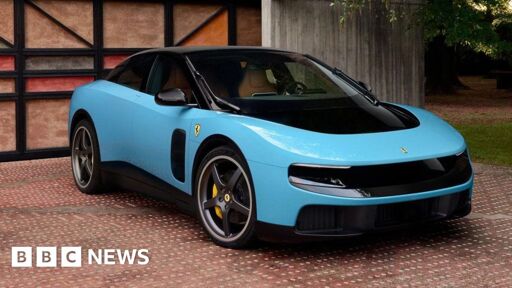
Nobody commenting on
I do not see any scenario where this could go wrong. Oh wait…
What’s the issue? As I understand it, that’s basically how all EVs work. Other than specifically being made by Ferrari.
If it’s the Ferrari thing, give them a chance. I haven’t heard about them royally screwing up tightly coiled cables yet, but I’m sure they could find a way.
No, I might be behind the times on this but usually you power axles, do you not (really naively asking)?
I would imagines any disruptions only affecting one wheel instead of axle being rather catastrophic. The brakes are also always set up in a way that you don’t brake on one wheel only even if it’s damaged.
So uncoupling all 4 wheels seems like a really really bad idea. Of course you can compensate this electronically, but that will work about sd well as the Boeing 737 max with its issues. There are physical things you should not mess with.
But maybe as I said I am behind the times and with electric cars that’s normal now to power wheels (l/r) separately?
When a car turns, one side’s wheels have to rotate faster than the other side as it needs to travel further.
Thus, it’s advantageous to be able to power wheels independently.
It’s not uncommon. Rivian, Rimac, and various Chinese cars all have IWD (Individual Wheel Drive.) For a rather longer time, trams have been running with stub-axles and individual motors for decades.
All the super-fast EVs from the Model S Plaid and Lucid Air Sapphire to the Rimac Nevera have used separate L/R motors in the rear for some time now, and some have been separate motors for all four wheels. I think that includes some Rivians, and definitely the Nevera.
Keep in mind that having an electric motor per wheel would be nothing like having a gasoline engine per wheel. Not only can an electric motor change its thrust thousands of times per second for good traction control, it can also apply regenerative braking or even just let the motor spin freely.
I assume the cars are at least monitoring the current to each motor constantly, so it’s just a programming decision when the LR motor fails whether to go into limp mode vs still sending 500hp to the right rear wheel to see what happens.