
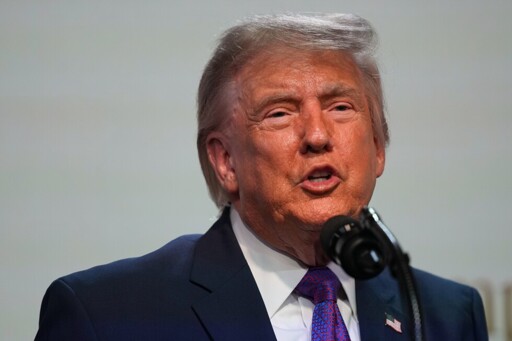
The Trump administration on Monday announced the creation a $1.7 billion fund to compensate allies of the Republican president who believe they were mistreated by the Biden administration Justice Department.

The “Anti-Weaponization Fund” was announced by the Justice Department as part of a deal to resolve President Donald Trump’s lawsuit against the Internal Revenue Service over the leak of his tax returns.

Acting Attorney General Todd Blanche said in announcing the fund in a statement that it was “a lawful process for victims of lawfare and weaponization to be heard and seek redress.”

Democrats and government watchdogs immediately pledged to fight what they called a “corrupt” and unprecedented resolution, warning that the arrangement would unjustly enrich people close to the president with taxpayer dollars and open the door to meritless claims of political persecution.

Trump’s lawyers disclosed the dismissal of the case in a filing Monday in federal court in Florida, where the president sued earlier this year.

The fund would represent not only a highly unorthodox resolution but also a further demonstration of the administration’s eagerness to reward allies who before Trump came to power were investigated and in some cases charged and convicted. Most notably, the president on his first day back in office pardoned or commuted the sentences of supporters who rioted at the U.S. Capitol on Jan. 6, 2021. His Justice Department since then has approved payouts to supporters entangled in the Trump-Russia investigation and investigated and prosecuted some of his perceived adversaries.

“This case is nothing but a racket designed to take $1.7 billion of taxpayer dollars out of the Treasury and pour it into a huge slush fund for Trump at DOJ to hand out to his private militia of insurrectionists, rioters, and white supremacists, including those who brutally beat police officers on January 6, 2021, and sycophant accomplices to his election stealing schemes,” Rep. Jamie Raskin, the top Democrat on the House Judiciary Committee, said in a statement.

Trump’s attorneys suggested in their court filing seeking to dismiss the case that the resolution would not be reviewable by a judge. But a group of 93 members of Congress filed a brief teeing up a challenge.

  • pelespirit@sh.itjust.works
    link
    fedilink
    arrow-up
    20
    ·
    2 days ago

    Streisand the shit out of his IRS payments. I pay more taxes than the billionaire trump.

    In 2019, The New York Times obtained partial information from transcripts of Trump’s IRS Form 1040s (the main personal federal tax form) from 1985 to 1994,[51] revealing that during that time Trump lost $1.17 billion—the most of almost any individual U.S. taxpayer[51][110]—evidently to avoid tax liability in eight of those years.[168][169] Trump has acknowledged tax advantages inherent to the real-estate business, such as large write-offs from using depreciation of property to generate losses and reduce tax liabilities, which according to the Times “cannot account for the hundreds of millions of dollars in losses.”[110][169][170]

    In the 18 years examined by the Times, Trump engaged in tax avoidance to a far greater extent than most affluent Americans (the top 0.001% of tax filers). Due to this avoidance, Trump paid “about $400 million less in combined federal income taxes than a very wealthy person who paid the average for that group each year.”[171] While in many years Trump ended with little or no tax liability, there is no evidence he ever failed to file a return or pay his expected tax burden by the annual filing deadline (including extensions), even if such payments were later refunded when the returns were completed.[51] Over two decades, Trump’s golf courses and other businesses regularly lost significant amounts of money, which is one way Trump was able to reduce his tax liability.[171] For example, in 2018 Trump reported $47.4 million in losses,[51] and since 2000, Trump reported total losses of $315.6 million from his golf courses alone.[51] While Trump had significant income in many years, including from The Apprentice, he placed millions of dollars into his businesses which recorded losses for the year.[51][173] Many of these businesses also claimed significant non-cash losses for depreciation of owned properties, but this cannot account for the entirety of the losses Trump claimed on his returns.[171] Trump Tower in New York is one of the few businesses Trump owns that turns an annual profit, but as of 2020 he still appeared to owe the $100 million mortgage which was set to come due in 2022.[171]

    Beginning in 2011, the IRS was auditing Trump’s $72.9 million tax refund covering multiple years of paid taxes; the audit was not resolved as of 2020.[51][171] If the IRS determines that the refund was improper, Trump would be required to repay more than $100 million,[51][171] which includes interest on the amount. Trump has also personally guaranteed $421 million in debt, most of which is due within four years. Trump previously expressed regret that he had personally guaranteed debt during the 1980s which brought him close to personal bankruptcy when his businesses faltered in the early 1990s.[51] The bulk of the debt came from Trump’s struggling Doral golf resort ($125 million) and the Washington, D.C., Trump International Hotel ($160 million).[51] Trump also had failed to pay back $287 million in debt since 2010, according to the Times “far more money than previously known”. Forgiven debt is supposed to be treated as income, but Trump used tax provisions to avoid or defer reporting it as such.[51]

    https://en.wikipedia.org/wiki/Tax_returns_of_Donald_Trump#Contents_of_returns