

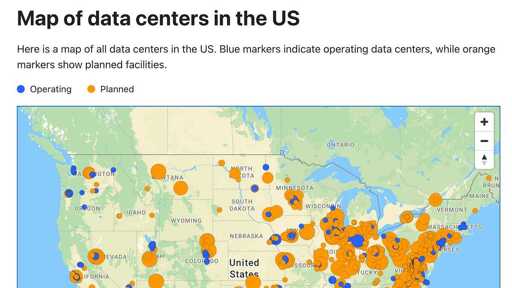
So, there’s a piece in Jacobin arguing that data center moratoria are a “terrible idea” making the rounds on social media and beyond. It’s pretty easy to see why this makes for some good discourse; naturally, there’s going to be frisson among AI optimists when a perceived opponent—here, the nation’s most influential socialist magazine—makes a case for aligning with the tech industry’s goals.
While I’m pretty unconvinced on all but one or two of the points that the piece itself raises, and I think it seriously misconstrues the class politics of data center fights, I do think it’s worth litigating this idea. Because I do believe we should be thinking about what a broader and more engaged politics of resisting, regulating, and ultimately governing AI might look like. It’s a good occasion, in other words, to ask:
- Who is fighting data centers?
- Why are they fighting them?
- Are anti-data center movements a dead end—or a starting point?
Watermarks for AI content is a non-starter, there’s no possible way to enforce this. Pandora’s box has been opened, and even if you mandated all the big AI companies do it, the open source models that exist (or will be developed) will be available to bypass it.
Nothing wrong with charging actual costs for electricity or expanding the grid with renewables. These are actually relevant ideas.
Noise pollution? I haven’t heard that one before. As long as the data centers aren’t running generators, the noise from them should be lower than almost any other industrial user.
They tend to have a massive amount of cooling units on top, which does create a lot of noise. There are also instances of the companies using portable diesel and even turbine generators to power their data centers, which has got to be infuriating to live near.
From that linked article.
Hundreds of feet!
They aren’t building these 50 feet from residential properties. I don’t think this is an actual issue.
Let me introduce you to Benn Jordan
Datacenters Behaving Like Acoustic Weapons
https://www.youtube.com/watch?v=_bP80DEAbuo
Forget charging “actual costs” for electricity, I think we should do like tax brackets and charge progressively more per kiloWatt-hour consumed. Let industry and corpo-sized services duke it out for who can consume the least, while protecting individual/personal use as well as small business, local-economy uses from the bigger actors throwing their weight around.
Who knows, we might even be able to ensure free electricity to keep the lights on for everyone with the right kind of bracketing.
True that there’s no way to enforce watermarks, but it could be required to mandate that paid AI models include an invisible binary watermark in the last digit of the, say, red colour channel, so odd bits form something like a repeating QR code relative to the even bits; require the fans in keyframes in AI produced video, too.
It wouldn’t work for text, obv, and this would be trivially easy to strip in post-processing, but it’s technically and legally possible, with low cost. Of course it wouldn’t affect local models, but not many people are running good image/video genAI locally anyway.