

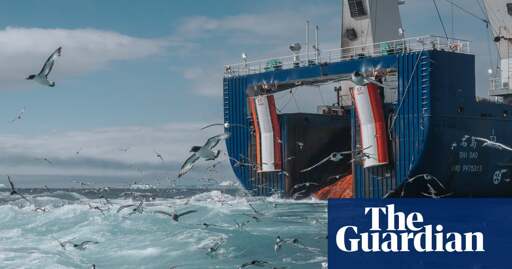
It is bitterly cold on the deck of the Allankay and the bosun, Luca Massari, is checking that none of us are wearing contact lenses before we descend into Antarctic waters. There is a risk, he warns, that lenses will freeze solid over the eyes. Massari himself is prepared for his surroundings. He is wearing thick goggles that make him look like an Olympic ski jumper.
Massari is a burly, heavily tattooed veteran of the environmental organisation Sea Shepherd, which campaigns against exploitating the oceans. His deck team are preparing to launch the ship’s small boat, which Massari will helm. Eight of us are bundled in bright red dry suits, helmets and lifejackets; the average time to survive hypothermia in this wind-whipped water is just five minutes.
I am in the waters off Coronation Island in the South Orkney Islands, a glaciated 25-mile finger of jagged mountain slopes a day’s sail from the Antarctic peninsula. It is as isolated as a place can be. Yet Sea Shepherd contends that it is the site of one of the most inaccessible and environmentally ruinous industrial workplaces on Earth.
Sea Shepherd is referring to fishing for krill – the small, shrimp-like marine crustaceans (Euphausia superba) that feed on plankton and are the main food source for larger marine animals. They also have a huge commercial value, turned into the ruby-red fish oil capsules sold in healthfood stores as well as the fishmeal used to give farm-fed salmon its pink hue. The trade is valued at more than $450m (£335m)a year.
Destroying the ecosystem to make sure we have access to… checks notes… fish oil capsules and pink fish.
now I want fish and chips.
Cries in whale
