

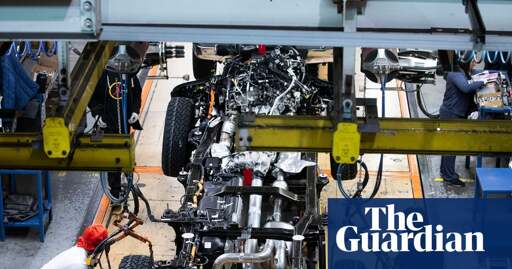
The dream of greasy overalls is driven by nostalgia and doesn’t justify policies that harm US consumers
The exhortations to protect America’s industrial muscle have resonated in the US at least since maverick presidential candidate Ross Perot brought up the supposed “giant sucking sound” of jobs pulled to Mexico by the NAFTA trade agreement back in 1993.
They flourished under Donald Trump’s first presidency and his promise to restore jobs lost to trade agreements. Joe Biden, too, put “rebuilding the backbone of America: manufacturing, unions and the middle class” at the center of his agenda. And in 2024, Trump reheated his old promise that “jobs and factories will come roaring back into our country”.
There is an undeniable appeal to the hard hat and the grease-stained overalls; to the sweat on the brow of hard men in vintage posters; to the virtue of a hard day’s labor on the production line. But the American political class would do well to overcome its nostalgia for the past and forget about promises to make manufacturing great again.
I think this way of thinking is massively flawed. I really hate this idea that economic “progress” must necessarily mean making and building fewer things, and instead “delivering services.”
One, “delivering services” often means charging rents, meaning you’re moving from an economy that creates real value to an economy that extracts rents. A rents and service fee economy isn’t really an economy, it’s just a machine that creates inflation.
Two, no matter how far your economy moves up the “ladder of success,” people are always going to need material goods. Houses can’t be built of financial services and food can’t be grown on spreadsheets. We need real stuff to have a real economy. So what this means is that the “graduated” economies must become net importers of real, physical stuff, and/or net importers of poor people to do the work here that can’t be as easily moved to another country. We must therefore become dependent on other nations to make the stuff we need. How can a nation maintain its independence if it is completely dependent on other nations for all of its vital products? That’s not an independent nation, that’s a vassal state.
Three, all of this assumes that there will always be countries in the world who never “graduate” to our economic level, otherwise who would make everything? But isn’t the idea for every country to strive to reach our level of “success?” If so, who will make all the stuff when most of the world’s population is rich, working white collar jobs? Martians? And doesn’t this create an incentive for us to try and keep at least some countries poor so they can supply us with the cheap goods and migrant labor we need?
Real economies make things and create real value, they don’t just move money around and charge rents. People don’t just stop needing material goods once they get rich enough, and someone has to make and build that stuff, it might as well be us. Otherwise, if we come to rely on other people to make our stuff, we lose our independence and our ability to be self sufficient. That’s not the road to “economic success,” that’s the road to economic ruin.
Articles like this are really just propaganda (wishful thinking) trying to soften the blow of Baumol’s Cost Disease:
https://en.wikipedia.org/wiki/Baumol_effect
Industries that benefit heavily from automation reduce costs over time. Industries that rely heavily on services (that require people to perform them) increase costs over time.
If you can somehow convert a big chunk of your economy into services from automated production, you can smooth out the difference in that economic curve. In theory, that means the rich (capitalists) can continue to get richer while everyone else’s salaries flatten out.
It’s total bullshit. The only logical end result of such a situation is the rich getting eaten sooner rather than later.
Smart rich people are (right now) lobbying to get their taxes increased to pay for a better social safety net. Stupid rich people are lobbying for bullshit like converting everything into a subscription economy.