

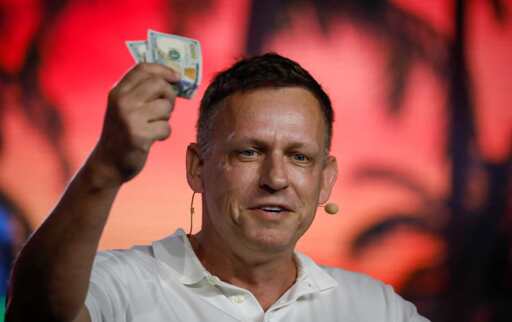
Thiel is all over the Epstein files; the two exchanged more than 2,000 messages over the years and met on multiple occasions. Epstein would ultimately invest some $40 million in venture capital funds managed by Valar Ventures, a firm cofounded by Thiel.
Thiel, whatever his deficiencies as a thinker, at least does the reading. He regularly pauses his ongoing pursuit of money to issue long and earnest disquisitions on the state of the world filled with learned references to dark philosophers like Leo Strauss and Carl Schmitt, the infamous Nazi apologist who’s undergoing a troubling revival on the groyper-infested MAGA right.
As their email exchanges make plain, Epstein and Thiel shared many of the same obsessions. Both had a certain disdain for the quotidian responsibilities that come with living in a society, like paying taxes: Epstein offered his clients advice on tax avoidance, and moved his operations to the Virgin Islands in part to escape the IRS; Thiel is currently helping to bankroll a campaign against a proposed wealth tax in California and talking about leaving the state in anticipation of steeper tax bills. Both were into life-extension and cryogenics (Epstein allegedly, Thiel for sure), though Epstein, hanging in his cell for a reported two hours after his death, clearly missed the window of opportunity to have his head and penis frozen, as he had evidently desired.
For both men, these end-time and antigovernment obsessions were rooted in a shared belief that democracy had failed and needed to be replaced by rule of the capable few. This is where Epstein saw the Brexit revolution headed, and the subsequent consolidation of maximum power around the nihilistic and bigoted tantrums of Donald Trump has drawn the world that much closer to the moment of reckoning he foretold in his note to Thiel.
Epstein was remarkably frank about his Spenglerian outlook. In a 2019 interview with Steve Bannon, he disdained politicians as incapable nothings whose power depended on popularity rather than expertise. “Many of these world leaders become world leaders because they’re popular, but they don’t understand money,” he groused. “They’re not scientists, they’re not intellectuals, they’re not great thinkers. They’re great politicians.” In order to have true “stability and consistency,” we would need to put the world into the hands of businessmen.
Thiel has been equally explicit. In a now-infamous 2009 essay for the Cato Institute, he declared that “I no longer believe that freedom and democracy are compatible.” But he’d made the point in far greater detail in an earlier essay on Strauss, in which he argued that elites must use “esoteric” doublespeak to hide their true intentions from the masses who wouldn’t and shouldn’t understand the plans their natural-born leaders were making for them.
This wasn’t idle theorizing. Both men put substantial resources toward building post-democratic infrastructure: Thiel through Palantir’s surveillance systems and his advocacy of utopian exit strategies like seasteading; Epstein through funding scientists and cultivating government insiders, most notably former Israeli prime minister Ehud Barak.
Thiel genuinely believes the world is entering end times, the literal battle between the Antichrist and what’s called the katechon—the restraining force that holds back apocalypse. Drawing on Schmitt’s concept of the political enemy, Thiel has identified various candidates for this cosmic villain: first radical Islam after 9/11, then the Chinese Communist Party, and most recently “Luddite” environmentalists like Greta Thunberg and anyone else who might put any sort of restraints on technological supremacy. As Paul Leslie notes in a perceptive essay in Salmagundi, the specific identity of the enemy seems to be “less critical to [Thiel’s] purpose than the fact that there is a target.”
In this framework, Epstein wasn’t a liability. He was a fellow accelerationist with useful connections and zero moral restraint. Schmitt convinced himself, at least for a time, that Hitler (yes, that Hitler) was the good katechon holding off the communist Antichrist. So it’s hardly surprising that a Schmittian like Thiel would be able to overlook Epstein’s moral depravity and see him as an ally in the fight against the Antichrist.
For both men, these end-time and antigovernment obsessions were rooted in a shared belief that democracy had failed and needed to be replaced by rule of the capable few. This is where Epstein saw the Brexit revolution headed, and the subsequent consolidation of maximum power around the nihilistic and bigoted tantrums of Donald Trump has drawn the world that much closer to the moment of reckoning he foretold in his note to Thiel.
For his part, Thiel didn’t just tolerate Epstein despite his crimes. He recognized him as a fellow traveler—someone who understood that democracy was ending, that hierarchy needed to be restored, that the masses were incapable of understanding anything about the world they lived in, and that people like them should position themselves at the center of whatever came next.
The difference between them wasn’t moral. It was tactical. Epstein may have preferred to talk about pussy, while Thiel stayed up late pondering philosopher Rene Girard’s concept of mimetic desire. But both were both asking the same question: How do we build a world where people like us have unlimited power and the rules don’t apply? Epstein couldn’t find an answer and died a pariah in a prison cell; Thiel, meanwhile, is continuing to hoard resources and audition katechons for the final battle ahead.
The last thing they wanted was to be provably right. Then they’re no longer special and in possession of knowledge no one else has