

6·
4 hours agoPrivate property, specifically your toothbrush, comrade.
There’s always someone who doesn’t know so I’m contractually obligated to say that by property we mean the means of production and not any other personal belongings.
| Pronouns | he/him |
| Datetime Format | RFC 3339 |
Private property, specifically your toothbrush, comrade.
There’s always someone who doesn’t know so I’m contractually obligated to say that by property we mean the means of production and not any other personal belongings.
Just because the concept of a “spectrum” is a useful metaphorical concept for these two things does not necessarily mean that the things themselves are all that analogous. In what way could one map the far end of the autism scale to anywhere on the “queer” scale? It’s nonsensical; apple & oranges. One is any sexual preference but the hegemonic one, where there are no “ends” to the “spectrum”, and the other is something that ranges from personality trait minutia to complete inability to function/survive independently.
they hate us for our democratic centralism

Wait ’till you see the Members of the Council on Foreign Relations. US corporate media (including social media) and the national security state / military-intelligence-industrial complex is one big club, and you ain’t in it. And it’s largely the same in the other imperial core states.
“Deep state” is actually a useful lens through which to view bourgeois democracies, it’s just nothing like the far right’s unhinged conceptualizations of it.
Michael Parenti, Dirty Truths
Those who suffer from conspiracy phobia are fond of saying: “Do you actually think there’s a group of people sitting around in a room plotting things?” For some reason that image is assumed to be so patently absurd as to invite only disclaimers. But where else would people of power get together – on park benches or carousels? Indeed, they meet in rooms: corporate boardrooms, Pentagon command rooms, at the Bohemian Grove, in the choice dining rooms at the best restaurants, resorts, hotels, and estates, in the many conference rooms at the White House, the NSA, the CIA, or wherever. And, yes, they consciously plot – though they call it “planning” and “strategizing” – and they do so in great secrecy, often resisting all efforts at public disclosure. No one confabulates and plans more than political and corporate elites and their hired specialists. To make the world safe for those who own it, politically active elements of the owning class have created a national security state that expends billions of dollars and enlists the efforts of vast numbers of people.
Aaron Good, American Exception: Empire and the Deep State
He is a national security risk, according to Wired.
He is a member of the national security state. He and the security state are deeply in bed with each other. Much of his income is from the military-intelligence-industrial complex, coming straight from the federal government. The US is an oligarchy, and he is one of the most powerful & influential oligarchs. He’s literally the richest person on earth at the moment, and already has enormous influence on the state.
Why did he buy Twitter? To control the conversation, to manage public opinion. He bought it to 1) censor it and 2) inject propaganda into it.
:surprised-pikachu:
On a scale of 1 to 10, how effective are the funky dyslexia typefaces?
When “it’s the least you could do” is a limbo contest.
You can’t find one. 
.
Are you playing some word game where kidnapping someone for the purposes of conscription does not qualify as kidnapping? What else would they be kidnapped for, a tickle party?
I mean he’s The Flash: blink and you’ll miss him 🤷
The number of people having no idea what’s going on is too damn high. This has been reported by many mainstream Western media outlets for months.

The unnamed U.S. lawmakers
The Kyiv Independent (despite NATO Bias/Fact Check’s opinion) is not a reliable outlet, so I’d take this with a grain of salt. This might be an effort to shift blame away from local government. But that doesn’t really matter, what matters is that the net for the meat grinder will be cast wider.

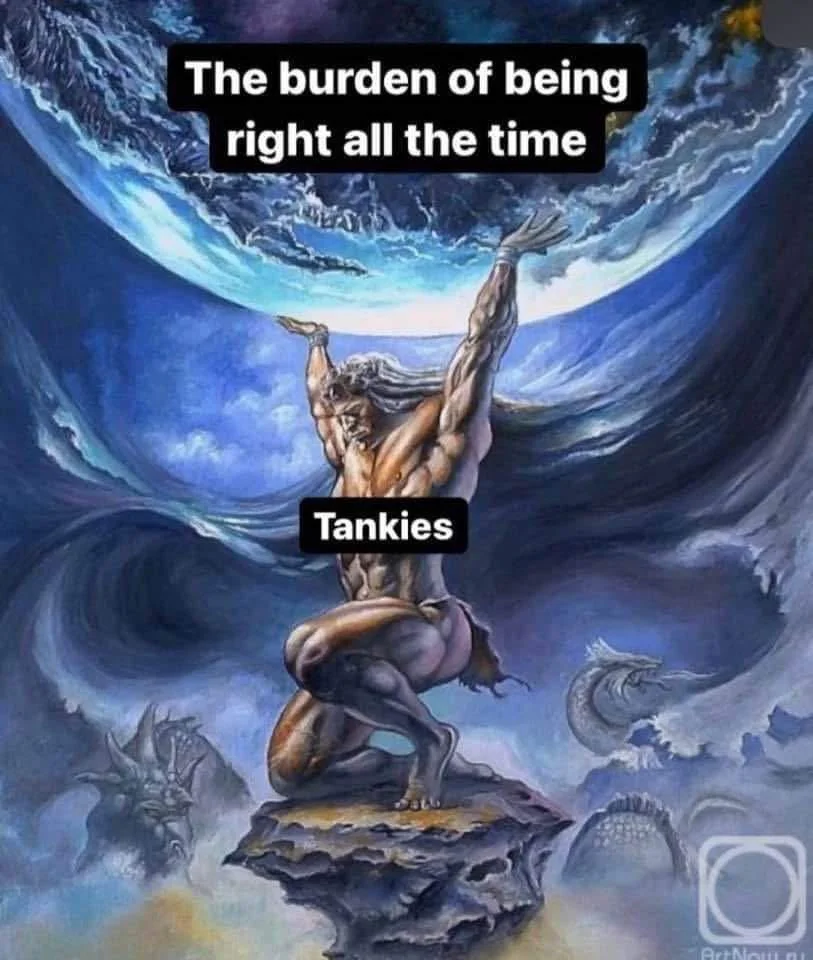
The famously unnuanced discipline that is dialectical materialism 😂
Bowie was packing in the girl-coming-of-age story. Wild stuff.
The past is a foreign country. France, I think.

Oooh, making a RISC-V SBC that apes the Pi’s layout & pinout is a clever idea.
Host: US warns Israel to boost humanitarian aid into Gaza or risk losing weapons funding.
Contestant: What is a fig leaf?














Careful, that’s how I caught pinko.