

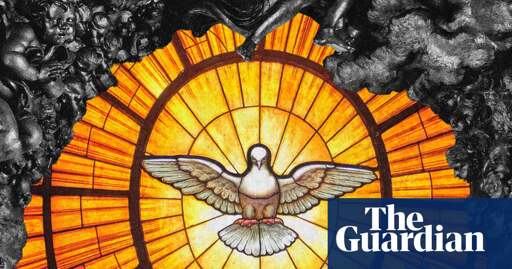
In the same way that America’s shambolic war on Iran has turned Donald Trump into the most effective EV salesman the world has ever seen, so his attempts to defend said war have produced another unlikely outcome: the rise of a genuine and global theological debate. Led by Pope Leo but extending across Christian denominations, it’s producing the sudden recognition that a kind of progressive Christianity long given over for dead seems to be stirring. Christ is risen, as it were – and if people of good faith push hard, the future could be redefined in powerful ways.
This story has developed so rapidly, with so many steps, that it’s hard to remember them all. When America launched its cruel attack, there was widespread reporting that some officers were exhorting to treat it as a prelude to the second coming. That provoked no pushback from the secretary of defense, Pete Hegseth, a representative of a tattooed Christianity (not that it matters, but have these people not read Leviticus?); indeed, with each press conference Hegseth edged closer to a revival meeting, invoking God’s blessing on his bombing and pillaging. “We are hitting them while they’re down, which is the way it should be,” he said.
Liberal Protestant leaders in America have pushed back in their ways, but their ways often go unnoticed. Virtually no reporter ever seeks out the head of the Methodists or the Lutherans or any of the other sects that once dominated American religious life. Real Christianity is always journalistically represented by evangelicalism – everyone knows its stars, the Franklin Grahams and the Paula Whites, the layers-on-of-hands in the Oval Office. Hegseth’s denominational leader, Doug Wilson, has gotten far more airtime than the heads of the much larger Protestant traditions, because they don’t do insane things like demanding women give up the vote. Partly as a result, a generation of Americans has grown up convinced that Christianity is a freak show, and another generation – those inside the evangelical tent – have grown old unchallenged in their thinking that scripture somehow demands the various cruelties we’ve seen play out in the “culture wars”.
But it doesn’t. In fact, for most of American history Christianity has been read in the opposite way, as a liberating force. Yes, slaveholders cherrypicked passages to assure themselves that human bondage was biblical, but for enslaved people, and an ever-larger abolitionist movement, the story of Exodus profoundly undercut that idea. Social movements of all kinds rode in on the back of the gospel: temperance, mostly supported as a defense of women against drunkards, was a religious crusade; to promote it, the Methodists built the building that is still the structure nearest the nation’s Capitol, the better to lean on the political class. That same building was used as the planning headquarters for Dr Martin Luther King’s March on Washington, an apex moment of a civil rights movement previously unimaginable outside the Black church. In those days roughly half of Americans belonged to these mainline Protestant churches. They were the consensus in America.