

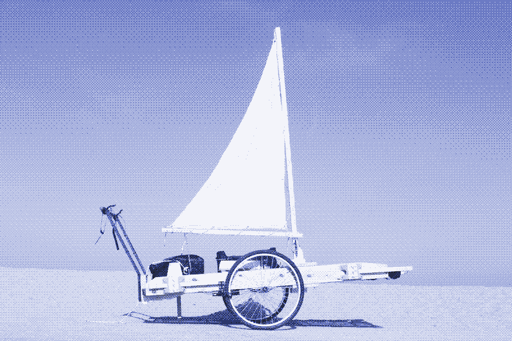
People still use large handcarts in so-called “developing countries”. However, they can be just as useful again in the large cities of the industrialized world, as I can testify after using one for a couple of months. Last autumn, I received an internship application from Kozimo, who studies at the Design Academy Eindhoven. In his application, Kozimo sent a video of a large handcart he made, which he was driving on the streets of Rotterdam, the Netherlands.
I have always dreamt of a handcart. I have never owned a car, and the only times I miss one are when I have to move stuff, something which has become increasingly common lately. Consequently, I proposed to Kozimo to build a handcart for me.
Now, I can no longer imagine living without it. I have used the vehicle to move houses and offices, pick up materials and objects I bought online, new or second-hand, and transport workshop and event materials (bike generators, solar panels, solar ovens, books, sound systems). I have done the same for friends. During these trips, I often took home materials, furniture, or objects that I found for free on the streets of Barcelona.
Unlike a van or a car, my handcart doesn’t need gasoline, electricity, or batteries, making it entirely independent from energy infrastructures. Neither do I need to pay taxes and insurance. The handcart is a very democratic vehicle. It allows anyone to carry a load wherever they want, while older, less affordable cars and vans are no longer allowed to enter city centers due to the installation of Low Emission Zones.
It would make a lot of sense to offer vehicles like this at community centers, where they are available for all neighbors to use when needed. Few people would need a handcart each day, and communal use would solve the parking problem. Although our handcart can also be parked vertically, it won’t fit in most apartments.
Yeh. Don’t mind it but have to agree handcarts do still exist and are used in many forms. This article kinda ignores that. I’d like to see more on how people have evolved the product rather than pushing a new design.
The photos drive me crazy. The artistic styling or tone of voice of imagery loses a lot of the detail. Design is the bling…message is the king.
It feels like an art assignment rather than an article.
People in Germany use personal shopping trolleys, bike carts and kindergarten carts (hand-carried with seats for children inside) a lot.
Same in NL.
Rotterdam, the Netherlands
Yeah … I think it makes more sense in somewhere very flat.
But in somewhere with hills and elevation changes, moving heavy things with a hand cart will become quite a chore … and maybe even dangerous, if the handcart doesn’t have adequate brakes for the weight on a steep hill.
Yeah, I live in Seattle. This would not work here as built. Disc brakes and an electric motor for hills would probably be a minimum requirement. That adds a lot of expense and engineering, and also means an e-bike and trailer are probably cheaper.
A pair of Chinese hub motors and a decent battery would probably make an amazing handcart. Just don’t charge it while you sleep.