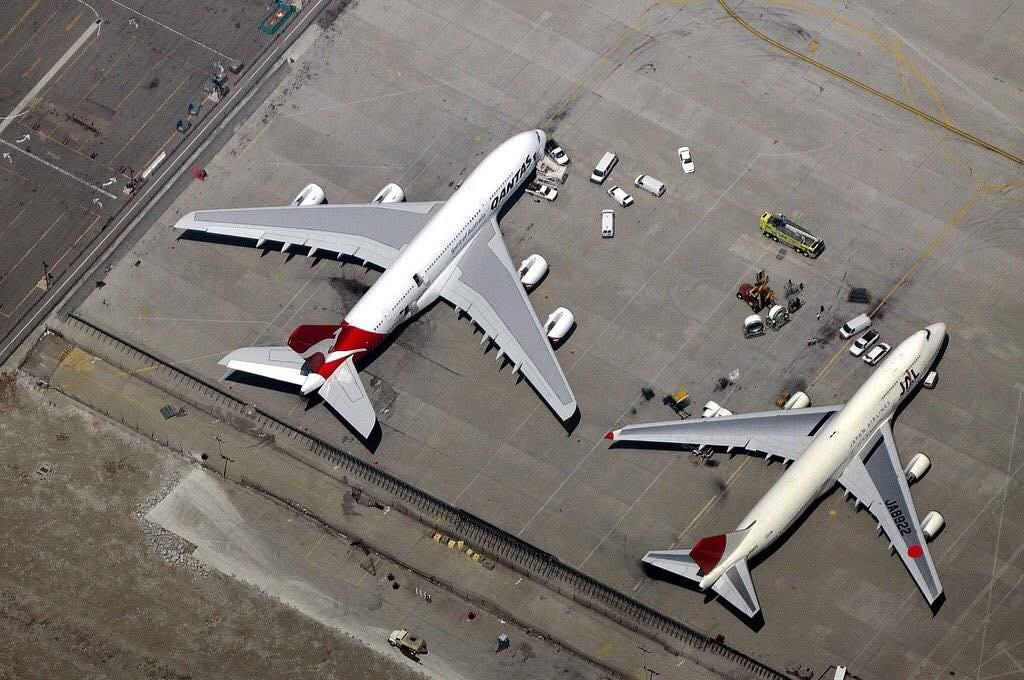

Crazy that the 747 was released in the 70s. In my mind it’s still what I picture as a commercial airliner.
If you spot an A380 at low altitudes (starting or landing) it looks like a flying building.
It flies through the air in a way that bricks don’t.
I might even go so far as to define it as such.
I’ve flown on the A380 several times and it is a very comfortable flight. Especially noise levels, which are much less than smaller passenger planes.
I’ve flown on it as well, and the quietness is really remarkable.
While all other passenger planes are smaller than the A380, it’s also far quieter than other very large passenger planes like the 747 and 777. Other modern designs making significant use of composites like the A350 and 787 are also not nearly so quiet.
Capacity 525 vs 366.
It holds 380 vs 747, duh
Short route, japanese spec 747s could seat 624. Similarly specified A380 would probably seat well over 1000.
I’m glad they made them wider instead of like , longer to fit more people lol
Taller, too. The A380 has an upper passenger deck for the full length of the aircraft, not just the 747’s hump up front. The length was constrained by existing airport gates. If it was longer, it would have hung out into the taxiways. (The wider wingspan and wheel base are still an issues, though.)
747 looks so small
It was just in the pool
Tell her Jerry!
Like a frightened turtle…
Does this continue to work at scale? Making everything proportional and such… I would guess they had to significantly increase the jet propulsion to compensate.
Since no one actually answered your question: basically yes, you can just scale airplanes linearely up and down. Obviously everything has to scale, like propultion and hydrolics power, but you can esentially make a model aircraft the exact same shape as any large aircraft and it will fly. Conversly, you can test a small model in a wind tunnel and then scale it up as much as you want and it behaves mostly the same way.
https://en.wikipedia.org/wiki/Reynolds_number
Not technically true, but I think when you are scaling up from an A380, it becomes much less relevant.
Thanks!
I would assume at some point you would have to worry about structural materials being able to hold up to weight being thrown around. It is remarkable how much wings can bend, but I figure at some point joints would need some kind of alternative.
Some are designed to have ~25ft (8 meters) of bend in the wings.
Nothing in the world really works at infinite scale because the size of atoms doesn’t change. In order for something to scale infinitely it also needs the environment in which it’s found to scale along with it.
Fun fact, the reason bees can fly is because, at their scale, the air is so thick that they’re actually doing something closer to swimming through it. A plane 6x as big would be, conversely, flying through incredibly thin air from its perspective.
Thanks!
This comment doesn’t actually answer OP’s aeronautics engineering question at scales of human life and plane manufacturing.
Who’s talking about scales of human life? He wanted to know if one could just keep scaling planes and what that would require, and since no else had said anything I gave what answer I could which did contain some helpful information on that subject.
No, he didn’t. Nobody is talking about scaling airplanes down to atomic or up to galactic scales. There’s an actual answer to OP’s question, which an aeronautical engineer could factually provide. You gave a worthless, ‘I am very smart’ non-answer and now double down as if OP was asking about some platonic ideal rather than a genuine engineering question.
Damn, somebody’s having a shit day, huh? You know this kind of negativity isn’t good for you, right?
Look at the size difference between the engines.
The A380’s are enormous.
They’re only about 10-15% more powerful. The 777 has far larger and more powerful engines, but only two of them.
Yeah. Those are huge on the 777.
Tumescent.