

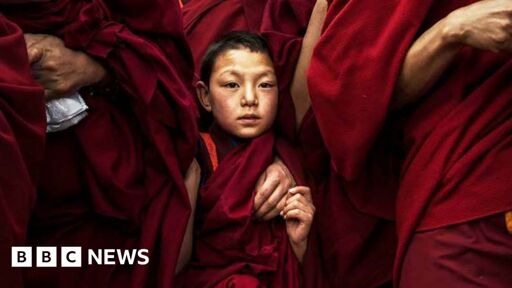
China has approved a sweeping new law which claims to help promote “ethnic unity” - but critics say it will further erode the rights of minority groups.
On paper, it aims to promote integration among the 56 officially recognised ethnic groups, dominated by the Han Chinese, through education and housing. But critics say it cuts people off from their language and culture.
It mandates that all children should be taught Mandarin before kindergarten and up until the end of high school. Previously students could study most of the curriculum in their native language such as Tibetan, Uyghur or Mongolian.
Can we please stop with the scare quotes around terms that don’t have the same connotation in their original language? The BBC is deliberately misleading its readers by translating 民族团结 to mean “ethnic unity”. A better translation in this case would be “national solidarity” but that wouldn’t sound as scary would it?
It’s also not unreasonable for a country to require schools to teach children the common language. Knowing 普通话 (the common language) is a critical skill for any Chinese national who wants to succeed in the modern Chinese economy. Almost every state with a national language does this in some way.
Instead of falling for deliberate mistranslations, maybe look up what was actually said in Mandarin next time.
I get that this is China fearmongering, but it’s also how France eroded and almost killed off the regional languages…, by stigmatizing their use in schools, posting exclusively french-speaking state workers in administrative roles, etc. under the guise of “national unity” or some other variation of it
This seems quite different.
Rather than stigmatizing their use in schools, they actively encourage them. China maintains dual language education in these languages. Literacy rates have gone from low single digit percentages to above 90 for every minority language in China I’ve checked.
It’s closer to how kids all over Europe were taught English. There are certainly many local dialects that are dying off but it’s by choice. When I was a kid in Austria, the “Waldviertler” dialect was generally considered low-class, as was my own “Ottakringer” dialect. Those have mostly died off but there are a bunch of people who keep “Wienerisch” alive because they think it’s cool.
Almost all the people I knew growing up in Austria speak English. It’s the language of business, TV, and Rock ‘n’ Roll. My dad thinks it’s cool when he can speak Shanghainese or Cantonese to people but he likes that he can speak Mandarine with people who natively speak one of the many other dialects.
There are serious practical benefits for people in China to learn Mandarin. It doesn’t seem to interfere with their ability to learn their native languages.
That’s great, thanks for sharing your experience. The value that mandarin or french or hindi or english have as a vehicular within their own borders (or beyond, in the case of english) is immense. Independentist velleities are not always a consequence of strong regional identity in my experience
What do you mean by “certain dialects are dying off by choice” ?
I can’t help but be reminded of my own Provençal (dialect of Occitan) when reading your bit about Waldviertler & Ottakringer being considered lower class. In the case of Occitan (in all its varieties), its “peasant” perception was encouraged if not manufactured by the state. The generation of my grandparents (early 20th) was physically reprimanded if they were caught using it.
That’s great if China is not going this route. For such a big country, levelling the cultural field would be such an immense loss
I’ve lived in the US for a really long time so a lot of this is out of date.
Waldviertel is a region near Vienna. They were poor farmers. When we used to visit family friends there, we’d pass the giant manure pile in the courtyard on the way into the living area. We’d walk right into the entrance/eating nook. There was one door to the kitchen, one to the bedrooms, and one that went directly to the pig stalls. You could hear and smell them while you were eating. They spoke a really thick Waldviertler dialect. I could not understand their grandmother at all. After the fall of the USSR that whole village slowly moved up the agriculture supply chain (ie storing grain, agricultural insurance, etc). Now they’re rich. The grand kids of those farmers converted the farm into a mansion and they all speak High German now.
Ottakring only became part of Vienna in 1892. For a long time it was an industrial working class neighborhood. My relatives and everyone I knew in the area went to “Volksschule”, that’s essentially vocational school. While a working class background is often romanticized, many people from that background want to disassociate with it.
I can’t understand old people when they speak Ottakringer but I still have enough of it that some people can identify me as coming from the 16th district, AKA Ottrakring. It’s kind of fun to dip into it when I speak with my family but there’s little reason to use it with other German speakers. Living in the US I have barely any reason to use German at all. Even when I run into people from Austria we usually find it easier to switch to English for actual work discussions.
Yes, we should criticise France’s capitalist government for this, you’re right. Go ahead and make posts on .world about it. How’s that related to China though?
Sarcasm isn’t getting anyone anywhere, if you want to communicate do so in good faith
This would be true if it weren’t for the biggest unrecognised genocide taking place against the Uyghurs
It’s not recognized because there was never a genocide. You can still be critical of China. You can say they carried out a heavy handed de-radicalization program where innocent people were forcibly imprisoned. That’s likely true. However, calling it genocide when the evidence is just not there to make such a claim just waters down the utility of the term, especially when a genocide that is recognized by the UN is ongoing in Gaza.
I find it funny how the people who claim to care the most about Muslims in China are also the same people who celebrate the murder of civilians in Iran
There are recognized minority languages in Sweden which children have a right to study as part of their public school education. My understanding is that they most commonly* have normal classes in Swedish, but can attend an additional course in their mother language as well as receiving tutoring help in that language for their standard courses. Is that how you’re saying this Chinese system will be run? And also can you link a source? I don’t mind if it’s not in English.
*Some schools are in other languages entirely, and I don’t understand what exactly the rules are, but I believe they’re private institutions.
Here’s a section of the law that explicitly calls out the states role in safeguarding the learning and use of minority languages.
www.npc.gov.cn/npc/c2/c30834/202603/t20260313_453201.html
Additionally the Ministry of Education explicitly calls on schools that primarily serve minority students to use texts and conduct classes in minority languages whenever possible.
www.moe.gov.cn/jyb_xwfb/xw_ft/moe_46/moe_1055/tnull_13924.html
The Chinese constitution also explicitly gives minorities the right to use and develop their language and culture.
https://www.gov.cn/guoqing/2018-03/22/content_5276318.htm
That said, there is conflict around the language of instruction in Chinese schools. It seems to me that China is moving more towards a model similar to what you’ve described in Sweden. In places where education was done almost entirely in a minority language, such changes haven’t engendered a degree of public dissent. I think it’s perfectly reasonable to discuss the merits of such changes. I just find it frustrating when western media projects their own history of cultural erasure and assimilation onto a China when that’s clearly not their intent.
The Chinese constitution also explicitly gives everyone the right to vote, freedom of speech, the press, assembly, association, procession and demonstration.
That says enough about how much that document is worth.
Yes, and those rights actually exist in China as intended. However, they obviously do not exist as you’re choosing to interpret their constitution. It’s fine to be critical of how they believe these rights should operate, but claiming that they’re being hypocritical or disingenuous disregards the actual intention of what they wrote in their constitution. I’m happy to explain.
For one, Chinese people do vote in competitive elections at the local level. Of course, the constitution explicitly guarantees the centrality of the communist party so elections tend not to be won over ideological difference but rather perceived competence. You can say that’s not democratic but this is not in contradiction with the constitutional right to vote or run for office.
As for freedom of speech and press, these too exist. Just go on platforms like Weibo and you’ll find people complaining about government policy and corruption all the time. Investigative journalism is legal as well and there are cases of corruption or other failures caused by poor governance that journalists have uncovered without facing any retribution. The difference here is that separatist speech, calls for regime change, or disinformation are not legal. What is separatism or disinformation is obviously defined by the people enacting these laws which I’m sure you would argue undermines these rights. Again, that’s a reasonable argument but it doesn’t mean these rights don’t exist.
Freedom of assembly and protest also exist. Protests are more common in China than most people in western countries realize. The government has a high degree of fear over how they might develop though and apply similar kinds of restrictive permitting requirements that occurs in many western countries. Also the second the protest has any separatist or regime change elements it will be shut down. However, again this situation is clearly what the constitution intended if you read it in full.
So please, critique the specific ways in which the Chinese government interprets the rights written in their constitution. However, there’s no evidence that the Communist Party was acting disingenuous when they wrote their constitution. It’s not a worthless document just because you want it to be.
And the same is true for the minority rights, they only exists as far as the Party wants to and allows at this moment, which was my point. I.e it’s mostly for PR.
The West isn’t any better at protecting minority rights, I’ll give you that.
That’s very helpful, thank you.
Who cares what they call it, the end result is the same.
The end result is not the same. The article is purposely misconstruing the intent of that which changes how a reader might imagine it will be enforced. There is a big difference between forcibly suppressing ethic culture and identity and instead trying to better integrate China by ensuring children learn the tools they would need to communicate with their peers across the country.
This same law contains provisions that actually protect minority languages. It guarantees the right to learn and use minority languages. It also contains provisions to help keep them alive by directing the government to help archive minority language texts and support the standardization of minority languages. There are also provisions that explicitly outlaw ethnic discrimination and suppression. Do you think these aspects of the law would have been included if the actual intent was to suppress minority identity?
Is it, though? Please provide us data on minority language usage over time in China, that would definitely show us