

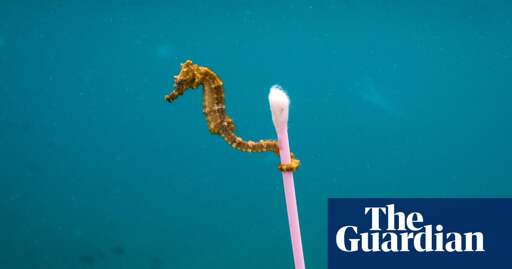
Like many of us who are mindful of our plastic consumption, Beth Gardiner would take her own bags to the supermarket and be annoyed whenever she forgot to do so. Out without her refillable bottle, she would avoid buying bottled water. “Here I am, in my own little life, worrying about that and trying to use less plastic,” she says. Then she read an article in this newspaper, just over eight years ago, and discovered that fossil fuel companies had ploughed more than $180bn (£130bn) into plastic plants in the US since 2010. “It was a kick in the teeth,” says Gardiner. “You’re telling me that while I am beating myself up because I forgot to bring my water bottle, all these huge oil companies are pouring billions …” She looks appalled. “It was just such a shock.”
Two months before that piece was published, a photograph of a seahorse clinging to a plastic cotton bud had gone viral; two years before that England followed Wales, Scotland and Northern Ireland and introduced a charge for carrier bags. “I was one of so many people who were trying to use less plastic – and it just felt like such a moment of revelation: these companies are, on the contrary, increasing production and wanting to push [plastic use] up and up.” Then, says Gardiner, as she started researching her book Plastic Inc: Big Oil, Big Money and the Plan to Trash our Future, “it only becomes more shocking.”
Her research took her to Reserve, Louisiana, in the Lower Mississippi River, where she met Robert Taylor, an activist in his 80s who has spent much of his life living by an enormous plastics plant. “He is surrounded by illness, by all kinds of cancers. He only found out in 2016, as a result of federal action, that the levels of toxic gases had gone through the roof in his area, an overwhelmingly Black neighbourhood. He told me about all the illness in his family – affecting his wife and his daughter, his neighbours and his cousins. It was haunting. When we talk about plastic, we tend to think about the ways we experience it in our own lives, and we’re not as aware of the production and the impact it has on the people who live beside it.”
Plastic production has doubled since 2000 and less than 10% gets recycled. The oil industry is actively poisoning the planet for quarterly profits. There is no solution besides ending mass plastic production, but that seems like a nonstarter. Just another neverending global disaster to be conveniently ignored.
They’ll tell us they have bigger problems (distractions) to worry about like immigrants, war for oil, Epstein… Meanwhile climate change is going to kill us all. If life were a movie, now would be the part when humanity unites against evil and we fight back hard. If it’s not too late.
I’m losing faith in homosapiens as a species. Or at least our capacity to adapt to our emergent modern civilization.