

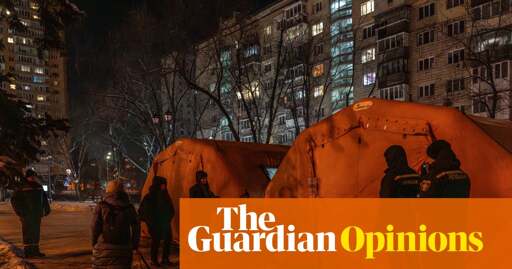
In the winter of 1993, during the siege of Sarajevo, people burned books and furniture to keep warm. Water froze in pipes. Electricity vanished for the duration of the war. Children slept in coats and hats, their breath visible in dark rooms. Cold itself became a weapon of war.
I remember, when I was reporting from the Bosnian capital, seeing doctors operating by candlelight or wearing camping headlamps. I remember old people chopping wood in the park in the centre of the city until there were no trees left, then dragging it home on sledges. I remember the ground being too frozen to bury the many dead on the football pitch, which later became a cemetery. I remember a terrible, frozen day when I went to an old people’s home near a frontline and counted dead body after dead body, all frozen in their sleep.
Three decades later, I am watching another winter war – this time in Ukraine. It is a human-made catastrophe. Russia is now systematically targeting the country’s energy infrastructure.
Since last mid-autumn, attacks on power and heating systems across eastern, central and southern Ukraine – including Kyiv, Odesa and Kharkiv – have forced daily electricity outages. Until December, power cuts followed a grim rhythm: four hours on, four hours off, all day and night. Twelve hours of light and warmth, 12 hours of darkness and cold.
According to Ukraine’s minister of economy, Oleksii Sobolev, the total damage to its energy infrastructure from these attacks over the past three months will cost an estimated $1bn to address. But no statistic can capture what it means to live in a city where winter has been deliberately turned into a tool of terror.
There is such a statistic. Life in freezing conditions causes death, illness and loss of productivity.
Old people risk blood clots. After the situation passes, statistics will absolutely show excess mortality. Everyone will risk respiratory infections and pneumonia. Utility workers risk overworking and some in Ukraine have indeed died from obviously doing it.
Heating systems will need renovating because of pipes bursting from cold, and non-critical companies may not have power to operate their business (although most will likely have a generator and battery bank by now, but not enough to generate process heat for industrial stuff). This has economic impact.
It’s pretty bad. Fortunately EU countries produce more transformers and power pylons than Russia produces missiles, but the loss of communal heating during a cold wave has severe consequences.
In an irony of fate, the power grid in Russia’s northernmost port city of Murmansk also collapsed… under wind and snow. Several power pylons from the 1960-ties couldn’t take it any more. They plan to spend the next week in the same style.
Last I read, Ukraine is looking to replace large co-production plants with a considerable number of very small ones. If your community is at risk of war or disaster, but considering a big power station or electrical junction, or an overhead high voltage line… maybe you can still change plans, build it smaller and distributed, or move something underground. Welcome to the bad new reality where Russia wrecks Ukraine while climate f*cks Ukraine, Russia and the US simultaneously.