

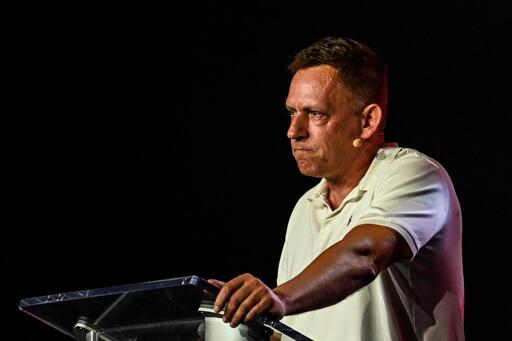
Peter Thiel’s visit to the Institute of France, a learned society in the heart of Paris, was kept secret until the very last moment. There, behind closed doors, he was due to speak at a meeting of members of the Academy of Moral and Political Sciences, a working group intended to discuss “the future of democracy.” The group, chaired by former minister Hervé Gaymard, has previously interviewed 25 figures, all French, mainly legal scholars, political scientists and historians.
Even Xavier Darcos, chancellor of the Institute of France, who oversees all five of its academies, was only informed of Thiel’s invitation at the last minute. The invitation has caused a stir within the institution, not only because Thiel, the American billionaire who co-founded the online payment system PayPal and Palantir Technologies, a data analytics giant that works for many governments, is one of the biggest investors in the American tech sector. Rather, it is Thiel’s political ideas, which openly contest democracy, that make his presence at the academy event decidedly provocative.
According to an outline of his speech sent to the academy, of which Le Monde obtained a copy in French, Thiel intended to introduce himself as “a moderate Orthodox Christian and a humble classical liberal, with one seemingly minor deviation from classical liberal orthodoxy: I worry about the Antichrist.”
Through Thiel, however, the academy is about to encounter a far more radical worldview. The Antichrist, a figure he has given sometimes-cryptic talks on, drawing from both the Book of Daniel in the Bible and the writings of 16th-century English philosopher Francis Bacon, does not, according to him, refer to the rise of artificial intelligence or the proliferation of imperialist leaders. Thiel claims that today’s Antichrist is anyone who expresses alarm about climate change, stokes fears of nuclear war or seeks to regulate the use of screens and social media platforms, all in order to promote the emergence of a “world government” – something libertarians, who are hostile to all forms of state regulation, dread above all.
I looked into his worldview a bit when the San Francisco lecture happened, and it is deeply, deeply fucked up.
There is a certain allure because it’s based on a well-known philosophal thread of “mimetic theory” (filtered through a then-contemporary Nazi apologist, and Silicon Valley hubris) and for all it’s “Anti-Christ” talk, it doesn’t even 100% require a supernatural belief system, just the commitment to one as an outward-facing and socially enforceable ideology. What makes it so fucked up and dangerous is the almost Foundation-like orthopraxy that it demands.
The gist, IIRC, is that humans want and need something stable to copy from to know what they want, and that modernish (like in the last 300 years) interpretations of major religions, but particularly Christianity, have landed on a perfect balance of giving people boundaries, aspirations, and just enough freedom to keep society going. Therefore, the only way to avoid falling back onto outmoded and dangerous practices like mass scape-goating is to get huge blocks of people invested in that worldview. Ideally it would be the whole world in one ideology, but their nod to reality is to concede that three or four could survive in tension if they’re geographically insulated.
So moving onto the Antichrist, anyone or (importantly for the Thiel version specifically) anything that poses an existential threat to this orderly control of society risks chaos and a descent into destruction and with a Christian context can therefore be comfortably called the/an “Antichrist.” If Palantir watching literally everyone and everything means the enforcement of “western” values on western populations, then opposing that is dangerous to humanity and therefore a threat. Fighting that threat is a crusade, and even justifies the interim use of tactics that will ultimately be rendered moot by the imposition of a religio-philosophical order, such as mass scaepgoating and pogroms (coughjdvancecough).
Then, just as the classist cherry on top, remember that the supernatural part of this is all just to make sure that the stupids buy into the same worldview as the elites who will preserve society by controlling it and directing it towards self-sustaining power structures. So a Thiel can be gay, and a Thiel acolyte like Vance (we’ll look past Musk for now, as I think they probably view him more as a lucky and useful idiot) can marry a Hindu woman from one of the viable global powerbases (though we’re seeing cracks in that as current political realities weigh on him), and he doesn’t even really have to believe any of the specifically dominionist nonsense he preaches, as long as the MAGA rubes do. What it does give them is a handhold where they can legitimately believe that they’re doing what’s best for the world by trying to dominate it, and that is fucking terrifying.
As an aside, Thiel’s philosophical mentor would have been very nearly as horrified as most of us are by the conclusions he’s reached, and this is why you don’t let the software engineers think they’re the only ones who are smart, simply because it’s harder to do calculus than write a B+ Freshman essay. If Girard is “love each other or we all face ruin,” Thiel is “love each other, or we all face ruin, but you’re too stupid to love each other unless a brutal technostate surveillance apparatus enforces adherence to a love-based religion.”