

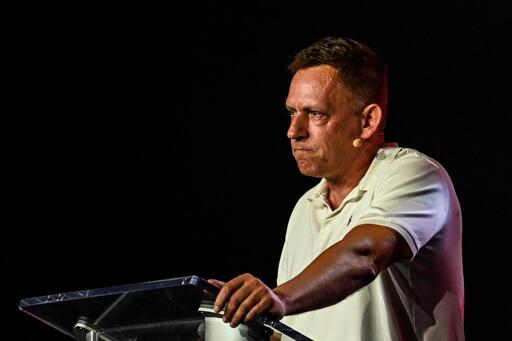
Peter Thiel’s visit to the Institute of France, a learned society in the heart of Paris, was kept secret until the very last moment. There, behind closed doors, he was due to speak at a meeting of members of the Academy of Moral and Political Sciences, a working group intended to discuss “the future of democracy.” The group, chaired by former minister Hervé Gaymard, has previously interviewed 25 figures, all French, mainly legal scholars, political scientists and historians.
Even Xavier Darcos, chancellor of the Institute of France, who oversees all five of its academies, was only informed of Thiel’s invitation at the last minute. The invitation has caused a stir within the institution, not only because Thiel, the American billionaire who co-founded the online payment system PayPal and Palantir Technologies, a data analytics giant that works for many governments, is one of the biggest investors in the American tech sector. Rather, it is Thiel’s political ideas, which openly contest democracy, that make his presence at the academy event decidedly provocative.
According to an outline of his speech sent to the academy, of which Le Monde obtained a copy in French, Thiel intended to introduce himself as “a moderate Orthodox Christian and a humble classical liberal, with one seemingly minor deviation from classical liberal orthodoxy: I worry about the Antichrist.”
Through Thiel, however, the academy is about to encounter a far more radical worldview. The Antichrist, a figure he has given sometimes-cryptic talks on, drawing from both the Book of Daniel in the Bible and the writings of 16th-century English philosopher Francis Bacon, does not, according to him, refer to the rise of artificial intelligence or the proliferation of imperialist leaders. Thiel claims that today’s Antichrist is anyone who expresses alarm about climate change, stokes fears of nuclear war or seeks to regulate the use of screens and social media platforms, all in order to promote the emergence of a “world government” – something libertarians, who are hostile to all forms of state regulation, dread above all.
I’ll just leave a translation of the french anthem here:
Let us go, children of the fatherland, The day of glory has arrived! Against us of tyranny The bloody standard is raised! (twice) Do you hear, in the countryside, Those fierce soldiers bellowing? They are coming right up to our arms To slit the throats of our wives & children!
To arms, citizens! Form your battalions! Let’s march, let’s march! Let an impure blood water our furrows!
What does this horde of slaves, traitors, And conspiring kings mean to do? For whom are these ignoble chains, These irons prepared long ago? (twice) French persons, for us, ah! what outrage, What transports it must excite! It’s us they dare think Of returning to the ancient slavery!
To arms, etc.
What! These foreign cohorts think They can make the law in our land? What, these mercenary phalanxes think They can overthrow our proud warriors? (twice) Good God! They think our brows will be bent Beneath the yoke by hands enchained? That vile despots will become The masters of our fates?
To arms, etc.
Tremble, tyrants, and you, perfidious ones, The shame of all parties; Tremble! Your parricidal plans Are going at last to receive their reward! (twice) Everyone’s a soldier to combat you. If they fall, our young heroes, The earth produces more of them, Completely ready to fight against you!
To arms, etc.
Frenchmen, as generous warriors, Deliver or withhold your blows! Spare those sad victims, Arming against you against their will. (twice) But those bloody despots, Those accomplices of Bouillé, All those tigers that, pitiless, Rend their mother’s bosom…grrr!
To arms, etc.
Sacred love of the Fatherland, Guide, sustain our avenging arms; Liberty, cherished Liberty, Fight alongside your defenders! (twice) Beneath our banners may victory Come in a hurry to your manly accents; May your enemies, expiring, See your triumph and our glory!
To arms, etc.