

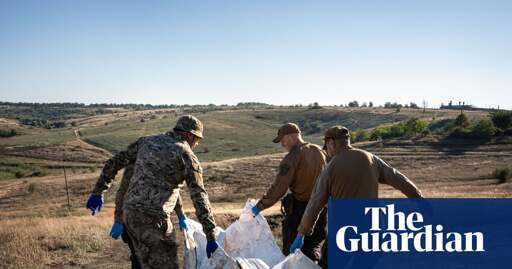
Alexei clears his throat without showing the slightest expression on his face. Squatting and wearing gloves, he shakes the military uniform that once belonged to a man. The jacket and trousers still hold their shape, but inside there is nothing. Just air.
Alexei pulls out a worn, stained piece of paper from one of the pockets. “Andrei. Moscow,” he reads aloud. “There’s a phone number written here. Good. It helps us trace his origin.” Whoever he was, he was a Russian soldier.
Alexei and his group of Ukrainian search volunteers face a complex, delicate task. They must identify the four bodies they have recovered from the front in the Donbas region. “If I were to die, I would want someone to search for me. To bring me home,” he says.
The search group, Platzdarm, goes where no one else goes, carrying the bodies of fallen soldiers for miles under the lethal dome that envelops the war front, guarded by legions of executioner drones. The so-called kill zone covers more and more ground, says Alexei, and there are barely any safe areas left. They now rely on fog to work, as it somewhat hinders the drones’ visibility. Almost making a pact with the haze, waiting for a moment to go in and retrieve the bodies, he says.