

- cross-posted to:
- [email protected]
- cross-posted to:
- [email protected]
In a monitoring room in Buenos Aires, a dozen members of the Argentinian coast guard watch giant industrial-fishing ships moving in real time across a set of screens. “Every year, for five or six months, the foreign fleet comes from across the Indian Ocean, from Asian countries, and from the North Atlantic,” says Cdr Mauricio López, of the monitoring department. “It’s creating a serious environmental problem.”
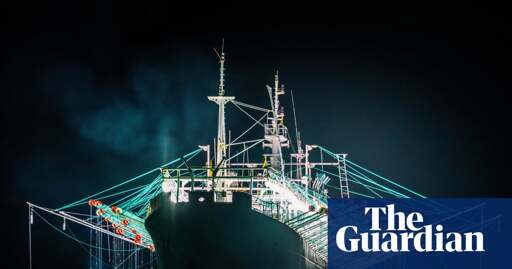
Just beyond Argentina’s maritime frontier, hundreds of foreign vessels – known as the distant-water fishing fleet – are descending on Mile 201, a largely ungoverned strip of the high seas in the South Atlantic, to plunder its rich marine life. The fleet regularly becomes so big it can be seen from space, looking like a city floating on the sea.
The charity Environmental Justice Foundation (EJF) has described it as one of the largest unregulated squid fisheries in the world, warning that the scale of activities could destabilise an entire ecosystem.
There are no internationally agreed catch limits in the region covering squid, and distant-water fleets take advantage of this regulatory vacuum.
The consequences extend far beyond squid. Whales, dolphins, seals, sea birds and commercially important fish species such as hake and tuna depend on the cephalopod. A collapse in the squid population could trigger a cascade of ecological disruption, with profound social and economic costs for coastal communities and key markets such as Spain, experts warn.
The Chinese fishing fleets carry significant weaponry, and wouldn’t think twice about shooting at any environmental groups.
They’d have to be equally sophisticated and ruthless.