

- cross-posted to:
- [email protected]
Banner image: Rhino populations across their ranges in Africa and Asia are threatened by poaching for their horns, which are in demand in China and Vietnam for medicinal uses and as a luxury item. Image by Harry Skeggs.
A former South African police officer who became a notorious alleged rhino-poaching kingpin has been killed by unknown gunmen, police announced. Joseph “Big Joe” Nyalungu was shot dead at his office in the town of Mkhuhlu, near Kruger National Park, at around 2:30 p.m. on May 16, according to authorities.
It was the second attempt on his life in eight days. He survived the first attack despite being reportedly shot in the shoulder, stomach and thigh.
Nyalungu, 62, faced multiple charges related to rhino poaching and trafficking, kidnapping and murder, as well as money laundering and unlawful possession of firearms and explosives. He was arrested at least five times between 2010 and 2024, though he was never convicted of any crimes during that time.
His latest arrest came in October 2024, when police found explosives in his offices. At the time of his death, he was reportedly out on bail of 20,000 rand (about $1,140 at the exchange rate at the time), with investigations into his alleged illegal activities ongoing.
Police said they haven’t identified the gunmen and are still investigating the motive behind the killing. Nyalungu was declared dead at the scene.

Conservationists say the only way to save rhinos from is is by creating stronger deterrents through tougher sentences for poaching and trafficking. Image by Thomas D. Mangelsen.
Nyalungu was accused of poaching rhinos in the Greater Kruger Area, said Jamie Joseph, director of the South African NGO Saving the Wild. Joseph has tracked Nyalungu’s activities since 2017 as part of her work to dismantle poaching syndicates operating in the country.
“This was way too kind of a death for him,” she said. “Joe deserved to go to prison for the rest of his life.”
Nina Fascione, executive director of the International Rhino Foundation, a conservation nonprofit, said Nyalungu was “likely behind hundreds, potentially thousands, of poached rhinos, not to mention other serious organized crime.”
“Poaching doesn’t just kill rhinos. Every year, rangers are killed in the line of duty,” she added. “It’s fair to say that rhinos and the rangers who protect them are safer today.”
Rhino horns are a prized wildlife commodity, worth about $20,000 per kilogram (about $9,090 per pound) on the black market. They’re in high demand in China and Vietnam for their purported medicinal properties (for which there’s no scientific evidence). The horns are also crafted into jewelry or carved into luxury items for display.
The international trade in rhino horns is prohibited under CITES, the global wildlife treaty that regulates cross-border commerce in endangered plants and animals. But horns are sawed off poached rhinos in Africa and Asia and smuggled across borders by organized crime syndicates. Chinese court cases reveal that many of the horns seized there can be traced back to South Africa and Mozambique.
South Africa has the world’s highest populations of both white rhinos (Ceratotherium simum) and black rhinos (Diceros bicornis). It’s also a poaching hotspot: 352 rhinos were poached there in 2025, according to government data. That was down 16% from 2024, when 420 rhinos were killed. Mpumalanga, the province where Nyalungu operated, recorded a steep loss: 178 rhinos were poached in 2025, up from 92 in 2024.

Joseph ‘Big Joe’ Nyalungu as he was being arrested by police after a high-speed chase in Hoedspruit in 2023.
Before Nyalungu’s troubles with the law began, he served as a police officer in Mpumalanga, a province that contains part of the Kruger National Park, where he later established his office.
His first brush with the other side of the justice system came in 2010, when police questioned him for his involvement in a murder and kidnapping case.
In 2011, police pulled him over and found 3.2 million rand in cash (about $441,000 at the time) and DNA evidence of two white rhinos that had been poached in Kruger National Park in his vehicle. He was arrested.
A year later, in 2012, Nyalungu was apprehended again following an undercover operation where he purchased rhino horns from a police informant. Authorities raided his home and found four horns, a substantial amount of marijuana, hunting gear, knives and gun silencers, along with 5 million rand in cash (about $609,000 at the time) in his home.
South Africa’s National Prosecuting Authority identified him as the ringleader of a rhino poaching syndicate in 2013. In response, the Pretoria High Court granted an order to freeze his assets.

S Data show that Kruger National Park park, a stronghold of Southern white rhinos rhinos, has lost nearly 75% of its population since 2011 to poaching. Image by splatzone via iNaturalist (CC BY-NC 4.0).
In September 2018, Nyalungu was arrested alongside two other alleged rhino poaching kingpins: Petros Sydney Mabuza, a.k.a. Mr. Big or Mshengu; and Clyde Mnisi, a traditional leader and chief of the Mnisi clan. Other ex-police officers were also apprehended in a roundup known as Operation Broadbill, which targeted suspected rhino traffickers. They faced criminal charges including theft, conspiracy, rhino horn trafficking and money laundering.
Past crimes caught up with Nyalungu in 2020, when he was rearrested for the 2010 kidnapping and murder.
Some of Nyalungu’s alleged co-conspirators are dead. Mabuza was gunned down in 2021 and Mnisi was shot in 2023, both in Mpumalanga.
Nyalungu was arrested again in 2023 after a high-speed chase, this time in Hoedspruit, a town about 70 kilometers (43 miles) from Kruger National Park. When police searched his vehicle, they found a stash of cash, knives, a rifle and ammunition.
In July 2024, Nyalungu appeared in court with his wife on tax evasion charges. Three months later, police raided his businesses and found explosives and a cache of ammunition linked to poaching operations. He was again arrested.
At the time of his death, he was facing 40 charges related to rhino poaching for crimes committed between 2016 and 2019, according to local media reports. These cases were ongoing in the courts.
Despite his long list of criminal charges, Nyalungu was never convicted. His court cases dragged on for years, and he kept getting out on bail.
“Unfortunately, there has been a tolerance in South Africa of extremely delayed and lengthy court processes, creating a massive backlog of cases,” Fascione said. “Big Joe should have been brought to trial years ago.”
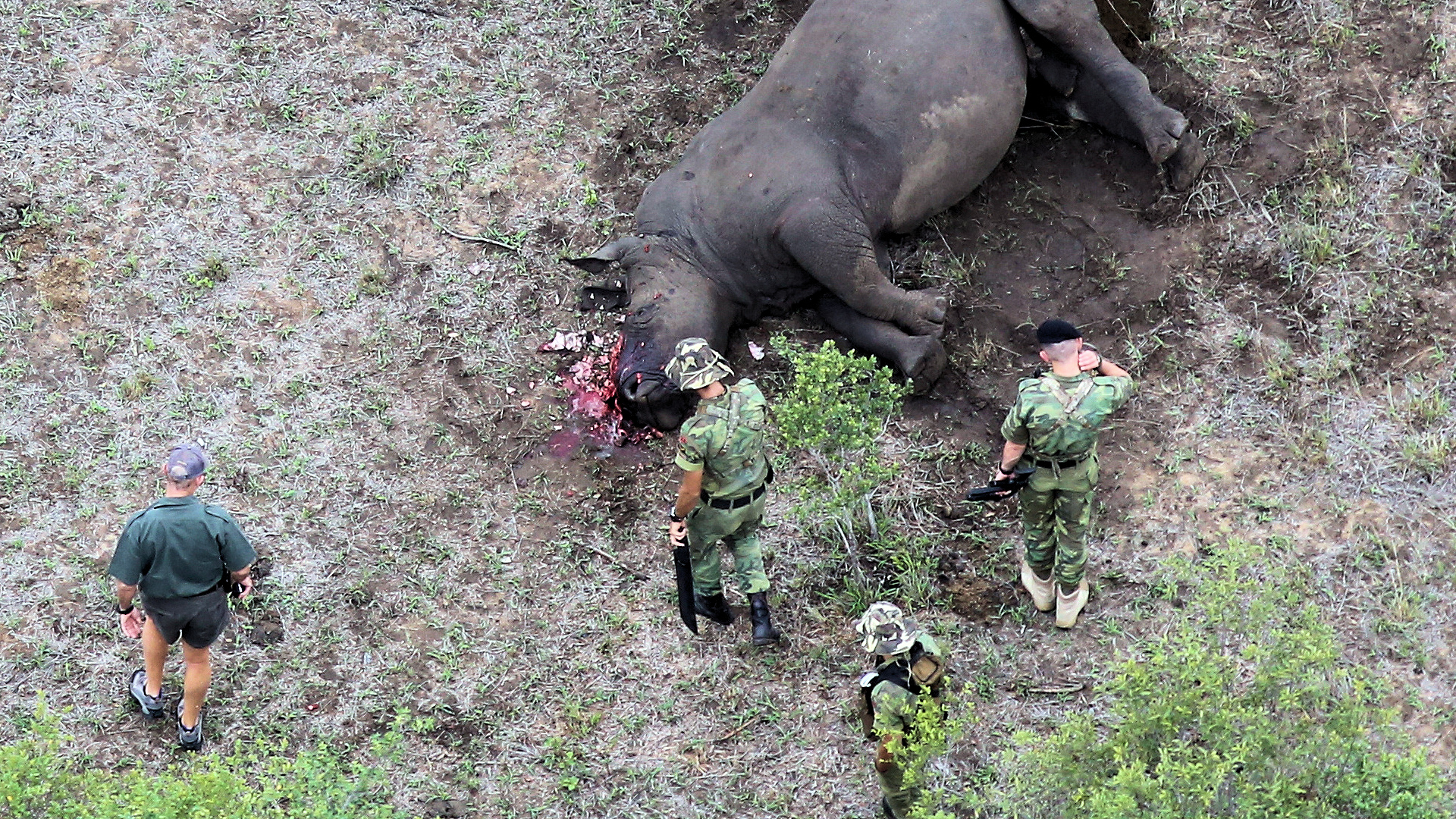
Nearly one rhino is poached every day in South Africa for its horns. Despite state-of-the-art anti-poaching efforts, the country is grappling with the crisis. Image by Wynand Uys via iNaturalist (CC BY 4.0).
Megan Carr, a senior researcher at the South African NGO EMS Foundation, said alleged rhino poaching kingpins, such as Nyalungu, “have historically utilized a variety of legal maneuvers and systemic weaknesses to delay trials and evade conviction for over a decade.” She referred to them as “Stalingrad tactics,” which wear down the plaintiff and delay justice. “These methods exploit the South African justice system’s procedural intricacies to stall high-profile cases indefinitely.”
Meanwhile, poachers continue to operate. “All the while, the poachers are out on bail killing more rhinos, so the rhino crisis will never end until there’s a deterrent,” Joseph said. “We have the best anti-poaching in the world, we have the best technology, weapons — you name it, we’ve got it all — we’re catching the same poachers.”

Critically endangered black rhinos in Kruger National Park. The park is estimated to have just 225 of them. Image by Thomas Fuhrmann via [iNaturalist](https://www.inaturalist.org/photos/142067169) ([CC BY-NC 4.0](https://creativecommons.org/licenses/by-nc/4.0/)).
Kruger National Park, South Africa’s largest protected area, is home to an estimated 2,515 white rhinos and 225 black rhinos. It’s also a poaching hotspot: Data show that between 2011 and 2020, 75% of the park’s white rhinos and more than half of the critically endangered black rhinos were killed for their horns.
Systemic corruption plays a part in perpetuating the poaching crisis. A 2023 research paper by the EU-funded ENACT program called “internal corruption” — and not poaching — the “gravest threat” to the park’s wildlife. The program, which tracks organized crime in Africa, found that as many as 40% of the park’s law enforcement staff are believed to be working hand in glove with poaching networks or are involved in other criminal activities. It also found the park’s corruption is tied to organized crime in Mpumalanga.
Carr also highlighted problems within the system. “The efforts to combat organized crime are significantly compromised by widespread criminality in the criminal justice system in South Africa,” she said. “These challenges are negatively affecting rhino poaching investigations and the protection of rhino horn stockpiles amongst others.”
In response, South African President Cyril Ramaphosa appointed the Madlanga Commission of Inquiry to probe the infiltration of criminal syndicates into law enforcement and the judiciary in 2025. The commission submitted an interim report in January 2026. The country’s anti-corruption unit arrested 12 police officers connected to a criminal syndicate in March 2026.
“Addressing the systemic governance and corruption challenges within law enforcement in South Africa must be considered a critical component.…to protect the remaining rhino population,” Carr said.

Rhino horns are a prized commodity on the black market, and organized criminal networks are involved in smuggling them from Africa to Asia. Image by [Rollison, Nan](https://www.fws.gov/media/rhino-horns) (Public Domain).
In 2017, South Africa opened the Skukuza Regional Court, its first-ever “rhino court,” inside Kruger National Park to fast-track poaching cases and bring criminals to justice. But its effectiveness has been interrupted by repeated efforts to transfer cases out by court president Naomi Engelbrecht — a move opposed by rhino conservationists.
Joseph said Skukuza is “the only court that was working in the country” to effectively prosecute rhino poachers, because prosecutors and magistrates there are specially trained to handle these cases. “If we can replicate specialized courts in a few places in South Africa where there are rhinos, then that’s a game changer.”
Most of those arrested in wildlife trafficking cases tend to be poachers or middlemen, who are the most easily replaceable links in the chain. Conservationists say the only way to cripple these networks is to arrest and prosecute the kingpins running these cartels.
“The criminal organizations behind rhino poaching are the same organized crime syndicates that run drugs, weapons and other dangerous and illegal activities,” Fascione from the International Rhino Foundation said. “More effort is needed to disrupt and dismantle these organizations, with swift and lengthy jail sentences that will deter other potential offenders.”
Joseph said: “The only thing that is going to save the rhinos is the rule of law — legislation and specialized courts. People have to start going to prison.”
Spoorthy Raman is a staff writer at Mongabay, covering all things wild with a special focus on lesser-known wildlife, the wildlife trade, and environmental crime.
Nyalungu, a former police officer, faced more than 40 counts of rhino horn trafficking

arrested at least five times between 2010 and 2024, though he was never convicted

Police said they haven’t identified the gunmen and are still investigating the motive

Other ex-police officers were also apprehended in a roundup known as Operation Broadbill, which targeted suspected rhino traffickers

At the time of his death, he was facing 40 charges related to rhino poaching
