

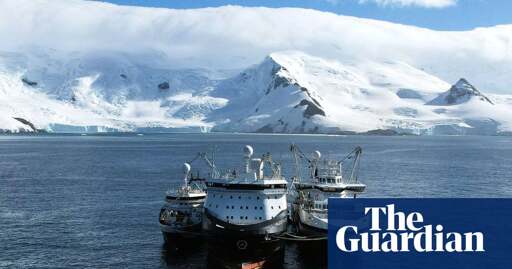
Environmental groups have objected to the recommendation of a “blue tick” sustainability label being awarded to a Norwegian krill fishing giant, amid concerns over concentrated fishing pressure and dramatic climate-driven effects on the Antarctic’s fragile ecosystem.
Norway’s Aker QRILL, the world’s largest harvester of krill, a tiny crustacean and keystone of Antarctica’s fragile ecosystem, and its sister company, Aker BioMarine, produce feed additives for aquaculture and dietary supplements for pets and humans.
Their krill products have carried the “blue tick” label operated by fishery certification scheme, the not-for-profit Marine Stewardship Council (MSC), since 2010.
Environmentalists say that since Aker was last certified as meeting MSC’s standard for a “sustainable and well managed” fishery in 2020, management of the entire Antarctic krill fishery has worsened, due to lapsed conservation measures.
To save someone a click, they’re worried about the hypothetical of way too much being taken from one local area. Although I have to wonder which predator couldn’t just move on; most of them are fast and have pretty huge ranges.
There’s so ridiculously much krill the limited human uses for it are a drop in the ocean, and there’s no worry of depletion more generally.
In the first seven months of the 2024-25 season, krill fishing in Antarctica reached 518,568 tons, about 84% of the 620,000-ton limit that, once reached, will force the fishery to automatically close. In one hot spot, the catch through June 30 was nearly 60% higher than all of last year’s haul, according to a report from the Commission for the Conservation of Antarctic Marine Living Resources, or CCAMLR, the international organization that manages the world’s southernmost fishery.
Trawling near Antarctica for krill has more than quadrupled in the past two decades and this season, for the first time, it reached its seasonal catch limit, triggering the unprecedented early closure of the remote fishery.
“The vast majority of the krill take is from an increasingly smaller area,” said Capt. Peter Hammarstedt, campaign director for conservation group Sea Shepherd Global, which this year made its third voyage to Antarctica to document the fishery. “It’s the equivalent of a hunter saying that they’re only killing 1% of the U.S.’ deer population but leaving out that all of the deer were shot in Rhode Island.”
Exactly.